
On This Page
Getting Started with REST Developer Guide
This section describes how to use this developer guide and where to find further
information.
Visit the
Cybersource
documentation hub to find additional
technical documentation.- Audience and Purpose
- This guide provides information about how to sign up for a sandbox account and set up theCybersourceREST API.
- Customer Support
- For support information about any service, visit the Support Center:
Recent Revisions to This Document
26.07.01
Updated the deadline in which HTTP signature messaging will no longer be supported.
See Introduction to REST.
Updated the
digest
body claim field value format information. For
JWTs using P12 certificates, see Step 3C: Set the JWS Body Claims
and for JWTs using shared secret key pairs, see Step 3C: Set the JWS Body Claims.26.06.01
Added the
request-host
field to the required JWS Body Claims
table. If you are using a P12 certificate, see Step 3C in Construct Messages Using JSON Web Tokens. If you are using a shared secret key pair,
see Step 3C in Construct Messages Using JSON Web Tokens. 26.05.01
This revision contains only editorial changes
and no technical updates.
26.04.01
- How to Set Up YourCybersourceAccount
- Updated the set up graphic to support the new SDK integration method. See How to Set Up REST.
- Construct Messages Using JSON Web Tokens
- Updated the body claim field descriptions for theexp,iss, andrequest-resource-pathfields.
- Updated the JWS body claim field descriptions to include lowercase format requirements.For both updates, see Step 3C in Construct Messages Using JSON Web Tokens using a P12 certificate and the Construct Messages Using JSON Web Tokens using a shared secret key pair.
- Enable Message-Level Encryption
- Updated the prerequisites list for enabling Messagel-Level Encryption (MLE). See the Prerequisites for MLE section in Enable Message-Level Encryption using P12 certificates and Enable Message-Level Encryption using shared secret key pairs.
- Corrected the spelling for all mentions of thev-c-response-mle-kidbody claim field throughout guide.
- SDK Integration
- Added new SDK integration section. See Set Up a JSON Web Token Message Using the REST SDK.
26.02.01
Added new section that explains how to migrate from HTTP signature messaging to JWT
messaging using a shared secret key pair. See Set Up a JSON Web Token Message Using Shared Secret Key Pairs.
Added a warning note with the deprecation deadline for HTTP signature messaging. See
Set Up an HTTP Signature Message.
26.01.01
This revision contains only editorial changes and no technical updates.
Introduction to REST
To get started using
Cybersource
APIs, you must first set up
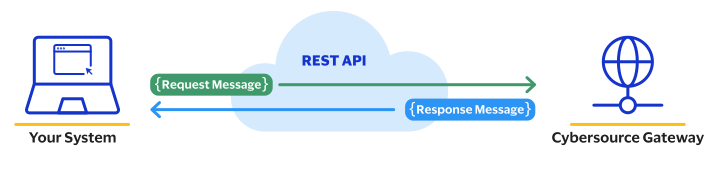
your system to be REST-compliant. Cybersource
uses REST for developing
web services. REST enables your system to exchange request and response messages with
the Cybersource
gateway using HTTP. This guide explains how to set up
secure messaging using JSON Web Tokens
or HTTP Signature Security
.
- JSON Web Token Messaging
- JSON Web Tokens (JWTs) are digitally signed JSON objects based on the open standard RFC 7519. These tokens provide a compact, self-contained method for securely transmitting information between parties. Depending on your integration, you can sign your tokens with a certificate private key or a shared secret key. The signature is calculated from the JWS header and payload, which enables the receiver to verify that the content has not been tampered with.WARNINGAs ofFebruary 2026, there are new requirements for constructing JWTs. This update also requires you to encrypt and decrypt messages using Message-Level Encryption (MLE). To remain compliant, you must update how your system constructs JWTs with MLE byMarch 2027. If you do not update your system before the March deadline, you risk transaction failure. Use this guide to update your system.
- HTTP Signature Security Messaging

- With HTTP Signature messaging, each request is digitally signed using a shared secret. This enables both the client and the server to validate the authenticity and integrity of the request. If a request is intercepted during transmission, an attacker cannot modify it or impersonate the sender without the shared secret key. HTTP Signature messaging can be used only with API requests and cannot be used in browser-based or mobile applications.WARNINGByMarch 2027, all merchants using HTTP signature messaging must migrate to JSON Web Token (JWT) messaging in order to support message-level encryption (MLE). You risk transaction failures if you do not implement this update. If you are setting up your system to be REST-compliant for the first time,Cybersourcerecommends using JWT messaging.
 Fraud Prevention and Security Responsibilities
Fraud Prevention and Security ResponsibilitiesWhen setting up your connection to the
Cybersource
gateway, verify
that you have implemented controls to prevent card testing and card enumeration
attacks on your platform. For more information, see the best practices guide.
If
Cybersource
detects suspicious transaction activity associated
with your merchant ID, including card testing or card enumeration attacks, Cybersource
reserves the right to enable fraud management tools on your
behalf to help mitigate the attack. The fraud team might also implement internal
controls that block traffic perceived as fraudulent.If you are already using a
Cybersource
fraud tool and experience a
significant attack, Cybersource
internal teams might modify or add
rules to your configuration to help reduce the threat to both your business and
Cybersource
infrastructure. However, these actions do not
replace your responsibility to follow industry-standard best practices to protect
your systems, servers, and platforms.How to Set Up REST
This overview lists the tasks you must complete in order to set up your
Cybersource
account for sending and receiving REST API messages using JSON Web Token (JWT)
messaging. You can choose from these set up methods:
- JWT messaging using aP12 certificate.
- JWT messaging using ashared secret key pair.
- JWT messaging using theREST Client SDK.
Figure:
Set Up Your
Cybersource
Account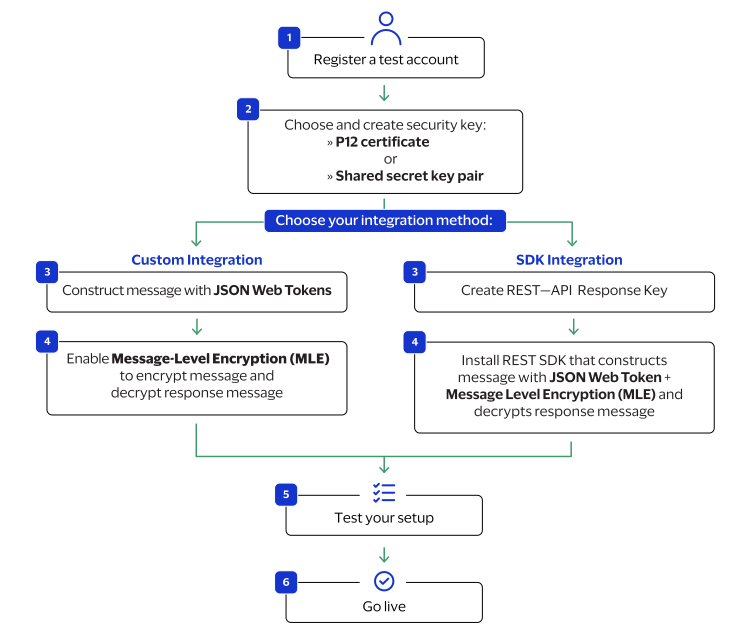
To set up JSON web token messaging using
P12 certificates
, see Set Up a JSON Web Token Message Using P12 Certificates.To set up JSON web token messaging using
shared secret key pairs
, see Set Up a JSON Web Token Message Using Shared Secret Key Pairs.To set up JSON web token messaging using the
REST Client SDK
, see Set Up a JSON Web Token Message Using the REST SDK.HTTP Signature Security
You also have the option to set up your
Cybersource
account for sending
and receiving messages using HTTP signature security.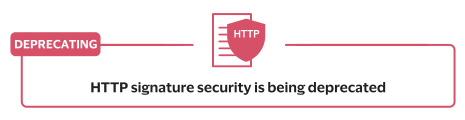
WARNING
By
March 2027
, all merchants using HTTP signature messaging must
migrate to JSON Web Token (JWT) messaging in order to support message-level
encryption (MLE). You risk transaction failures if you do not implement this
update. If you are setting up your system to be REST-compliant for the first
time, Cybersource
recommends using JWT messaging.To set up HTTP signature messaging, see Set Up an HTTP Signature Message.
Set Up a JSON Web Token Message Using P12
Certificates
To set up JSON Web Token messaging using a
P12 certificate
, you must complete the
tasks described in this section.Figure:
Setting Up JSON Web Token a Messaging
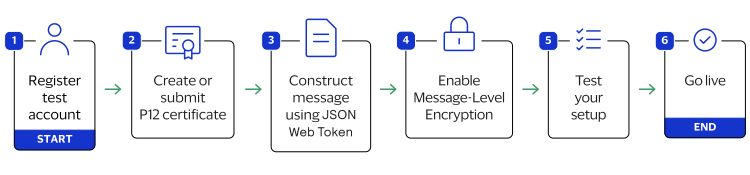
- Sign up for a test account. See Sign Up for a Test Account.
- Create a P12 certificate. See Create or Submit a P12 Certificate.
- Construct a message using a JSON Web Token. See Construct Messages Using JSON Web Tokens.
- Enable message-level encryption (MLE) to encrypt all messages. See Enable Message-Level Encryption.
- Go live by transitioning your sandbox account into a production account. See Going Live.
Sign Up for a Test Account
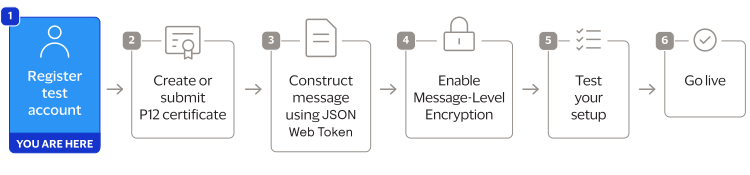
To begin setting up your account, you must first sign up for a sandbox test account. A test
account enables you to obtain your security keys and test your implementation.
IMPORTANT
A test account cannot process live payments and is intended for only testing.
Follow these steps to sign up for a
sandbox test account:
- Go to theCybersourceDeveloper Center test account sign-up page:
- Enter your information into the test account form, and clickCreate Account.
- Go to your email and find a message titled:Merchant Registration Details. ClickSet up your username and password now.Your browser opens the New User Sign Up wizard.
- Enter the organization ID and contact email you supplied when you created your account. Follow the wizard pages to add your name, a username, and a password. Your username and password must meet these requirements:Username and Password RequirementsUsername RequirementsPassword Requirements
- Length must be 3-36 characters.
- Can only contain letters, numbers, periods, dashes, or underscores.
- Length must be 12–50 characters.
- Must contain one upper case letter.
- Must contain one lower case letter.
- Must contain one number.
- Cannot contain the username or organization ID.
- Log in to theBusiness Center.When you log in for the first time, you must verify your identity through a system-generated email sent to your email account.
- Check your email for a message titled:. A passcode is included in the message.CybersourceIdentification Code
- Enter the passcode on theVerify your Identitypage.You are directed to theBusiness Centerhome page.You have successfully signed up for a test account.IMPORTANTA test account cannot process live payments. After you verify that your system can send and receive REST messages, you can contact customer service to transition your test account to a production account.
Create or Submit a P12 Certificate
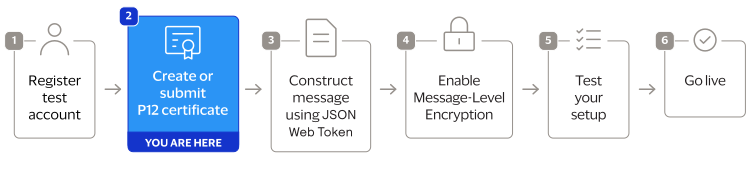
This section describes how to create or submit a P12 certificate, extract the certificate's
private key
, and test the private key to verify that it works. A private key
is necessary for you to construct JSON Web Tokens (JWTs). You can choose to create or submit a P12 certificate.
Create
a P12 certificate if
you need a new certificate. Submit
a P12 certificate if you want to use your own
certificate.- (Optional) Meta Keys
- If you are using a portfolio or merchant account, you have the option to create ameta keyof a P12 certificate. Meta keys enable an organization administrator to assign a single P12 certificate to some or all transacting merchants in their organization. The purpose of a meta key is to reduce the time needed to manage an organization's keys. For example, by assigning the same meta key to all of your transacting merchants, you only need to update one key when it expires instead of having to update each transacting merchant's key.
- For more information about meta keys, see the Meta Key Creation and Management section in theCreating and Using Security Keys User Guide.
Step 2A: Create or Submit a P12 Certificate
Follow these steps to create a P12 certificate file or submit your own certificate
signing request (CSR):
- Log in to theBusiness Center:
- On the left navigation panel, choose
 Payment Configuration > Key Management.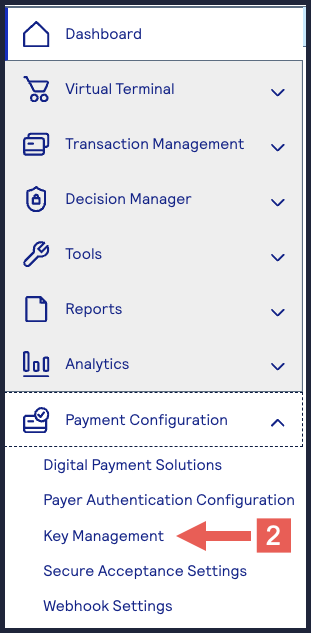
- Click+ Generate keyon the Key Management page.
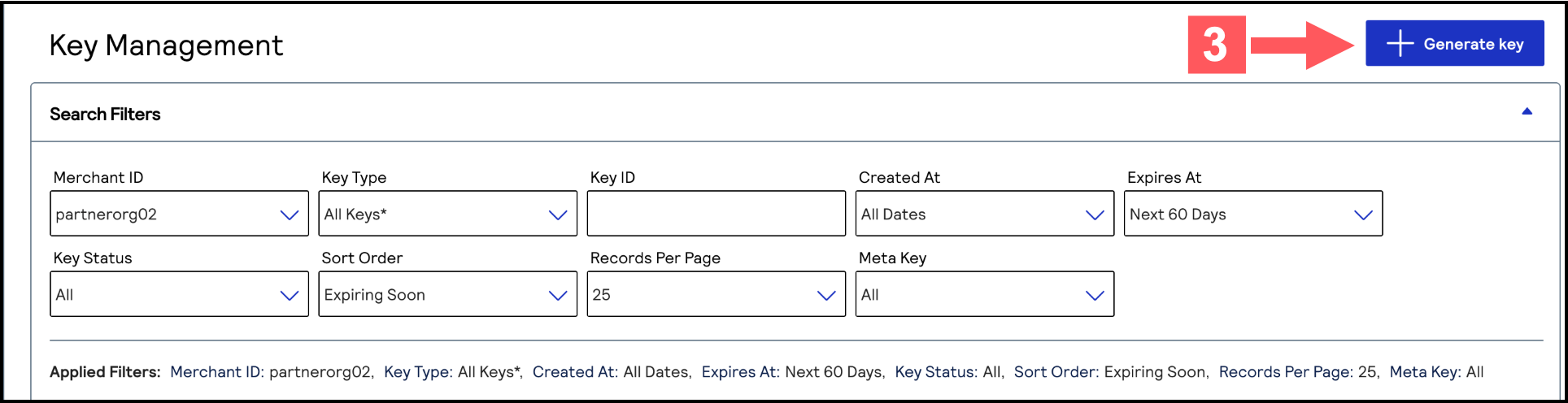
- Under REST APIs, chooseREST – Certificate, and then clickGenerate key.The Key Generation page appears.If you are using aportfolioaccount, the Key options window appears, giving you the choice to create a meta key.For more information about how to create a meta key, see .
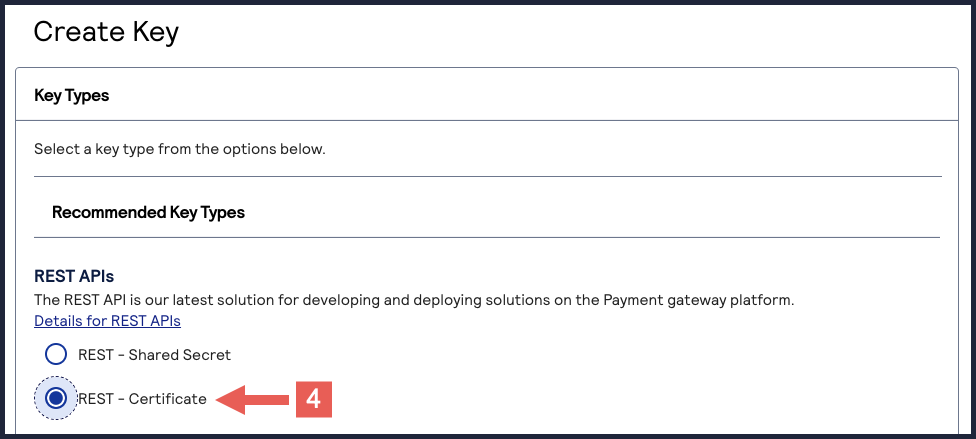 The Confirmation Key Generation window appears.
 - ClickDownload keyafter reviewing the key details.
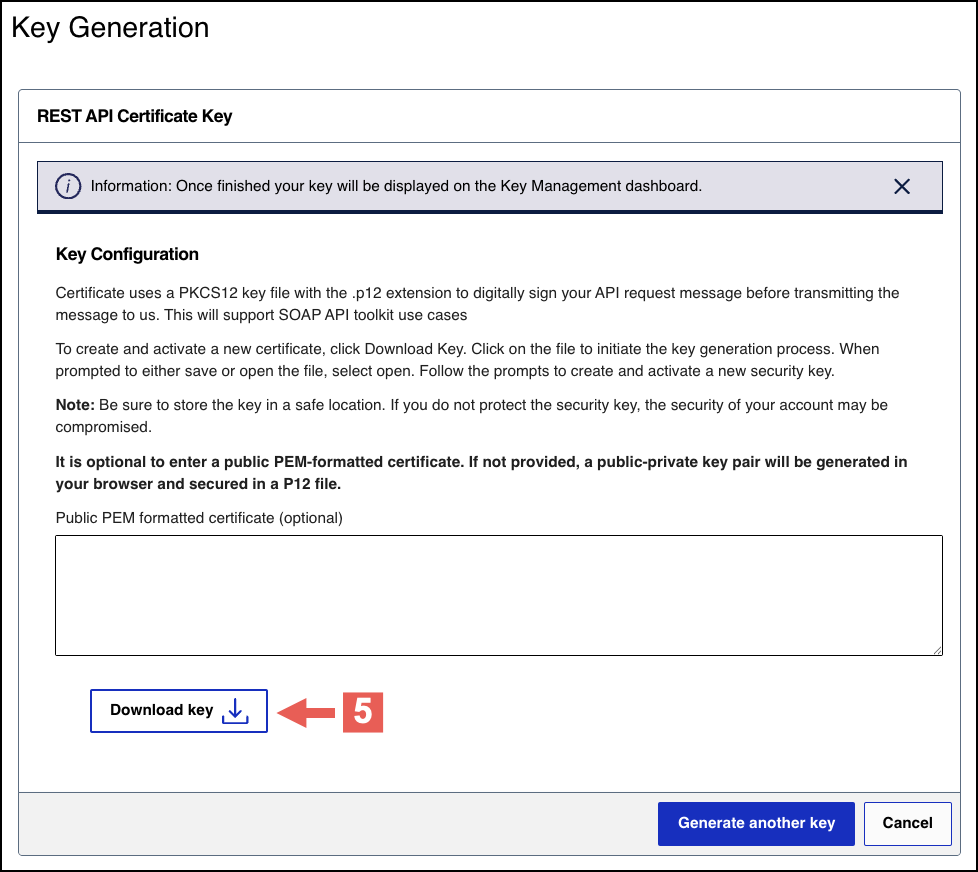
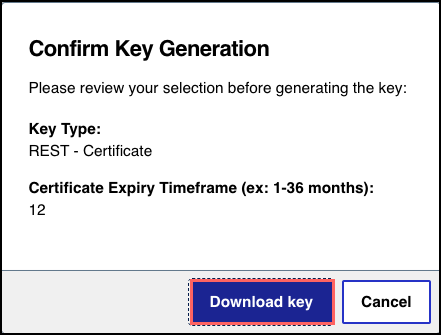 The Key Generation page appears.
 - (Optional) You can set the Certificate Expiry Timeframe field to the number of months you want the key to remain active before it expires. Only whole numbers from 1–36 are accepted. By default, new keys expire after 12 months.
- Choose from these two options:
- If you are a creating a new P12 Certificate, clickDownload key
 .
.
- If you are submitting your own certificate, enter your public PEM-formatted certificate in the text box, then clickDownload key
.
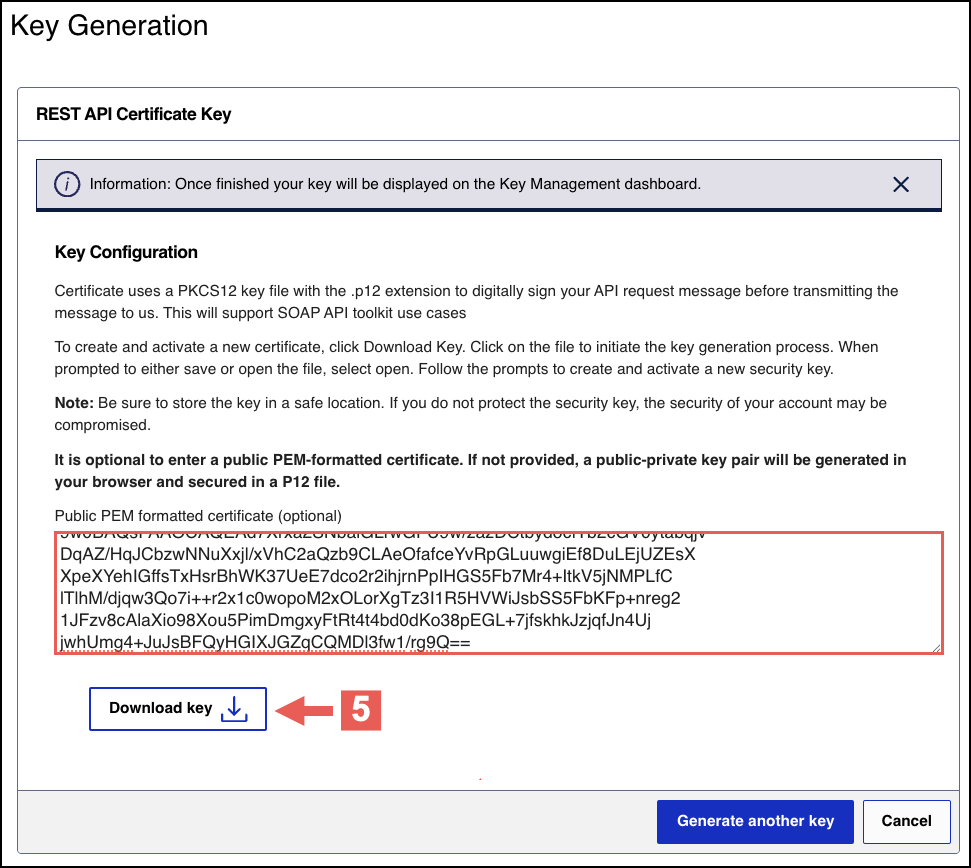
- Create a password for the certificate by entering one into theNew PasswordandConfirm Passwordfields. ClickGenerate key.
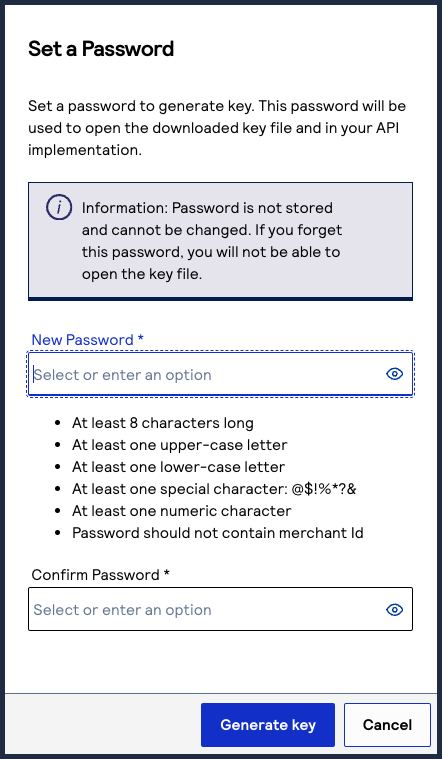 The.p12file downloads to your desktop.If prompted by your system, approve the location to which the key downloads.
To create or submit another key, click
Generate another key
. To view all of
your created keys, go to the Key Management page.IMPORTANT
Securely store the
.p12
file and password in your system. These
credentials are required in order to implement certain products, and you must be
able to access them.Step 2B: Extracting the Private Key from Your P12
Certificate
When you have your P12 certificate, extract the private key from the certificate. Use
this key to sign your header when sending an API request.
IMPORTANT
If you are using the SDK to establish communication, you do not need to extract the
private key from the P12 certificate.
- Prerequisite
- You must have a tool such as OpenSSL installed on your system.
- Extract the Private Key
- Follow these steps to extract the private key using OpenSSL:
- Open the command-line tool and navigate to the directory that contains the P12 certificate.
- Enter this command:openssl pkcs12 -in [certificate name] -nodes -nocerts -out [private key name]
- Enter the password for the certificate.You set this password when you created the P12 certificate in theBusiness Center.
The new certificate is added to the directory with the private key name you supplied in Step 2.
Step 2C: Testing Your Private Key
After creating your key certificate, you must verify that it can successfully process
API requests. This task explains how to test and validate your private key in the
Developer Center and the
Business Center
.Follow these steps:
- Go to the Developer Center's API Reference page:
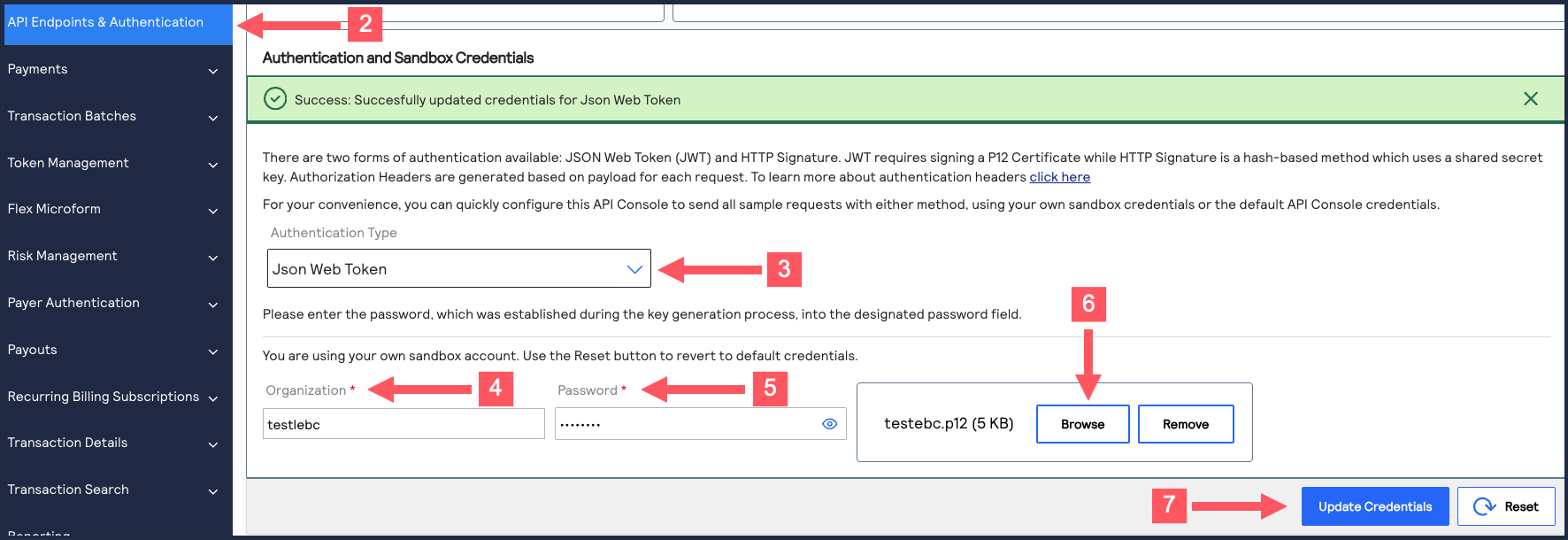
- On the left navigation panel, click .
- Under Authentication and Sandbox Credentials, go to the Authentication Type drop-down menu and chooseJSON Web Token.
- Enter your organization ID in theOrganizationfield.
- Enter your Password in thePasswordfield.
- ClickBrowseand upload your p12 certificate from your desktop.
- ClickUpdate Credentials.A confirmation message states that your credentials are successfully updated.
- Go to the Developer Center's API Reference and navigate toPayments >.POSTProcess a Payment
- ClickSend.
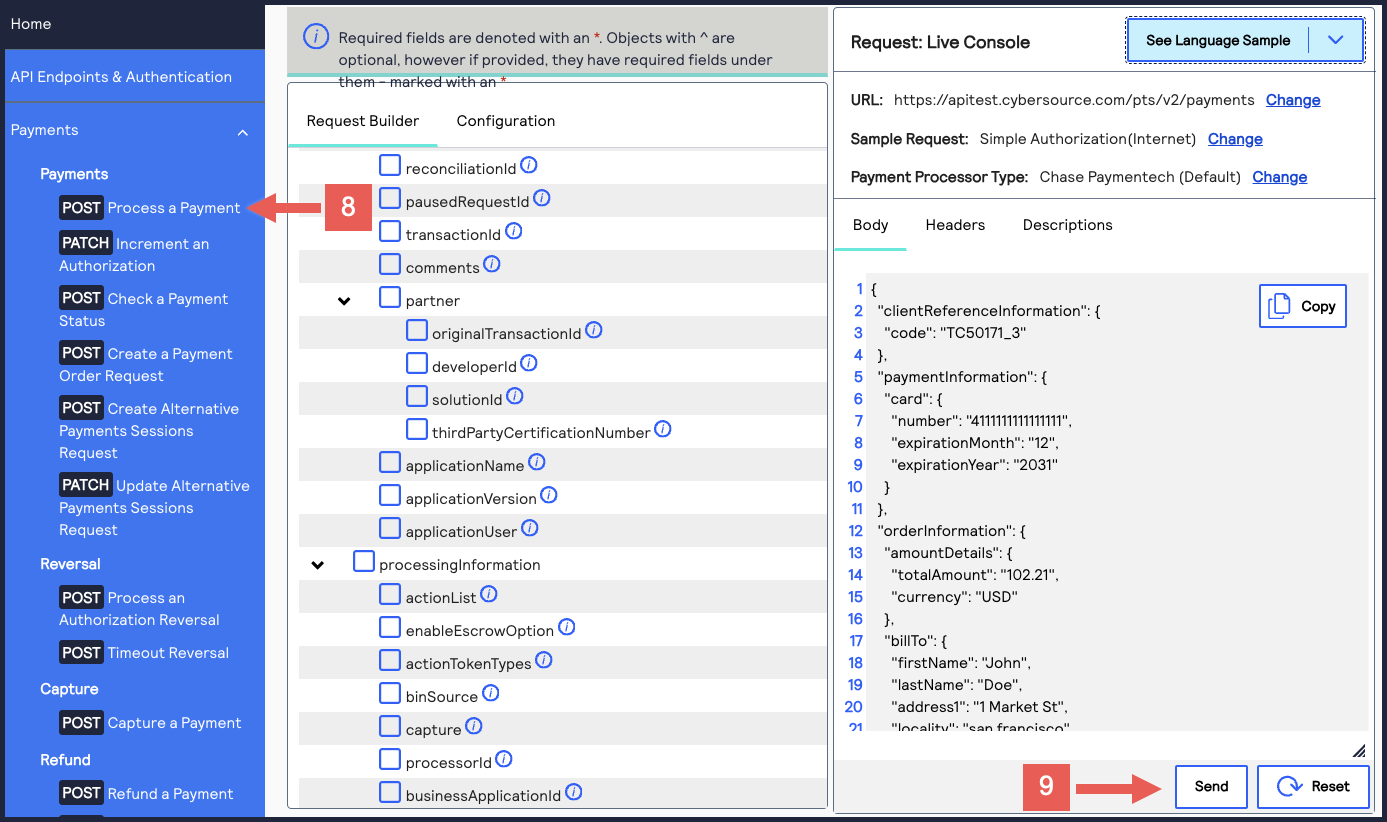 A message confirms that your request was successful with the status code 201.
- Log in to theBusiness Center:
- On the left navigation panel, choose
 Transaction Management > Transactions.
 - Under Search Results, verify that the request ID from the test authorization response is listed in the Request ID column.If the test authorization was successful, a success message is present in the corresponding Applications column.

Construct Messages Using JSON Web Tokens
WARNING
As of
February 2026
, there are new requirements for constructing
a JWT. This section explains how to update your system to remain in compliance. You must
update how your system constructs JWTs by March 2027
to remain compliant. You
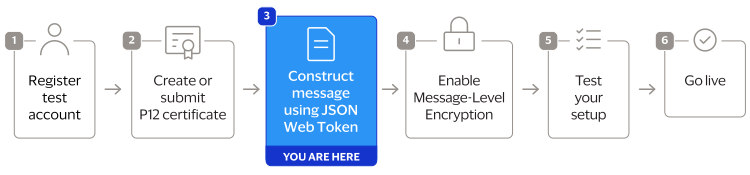
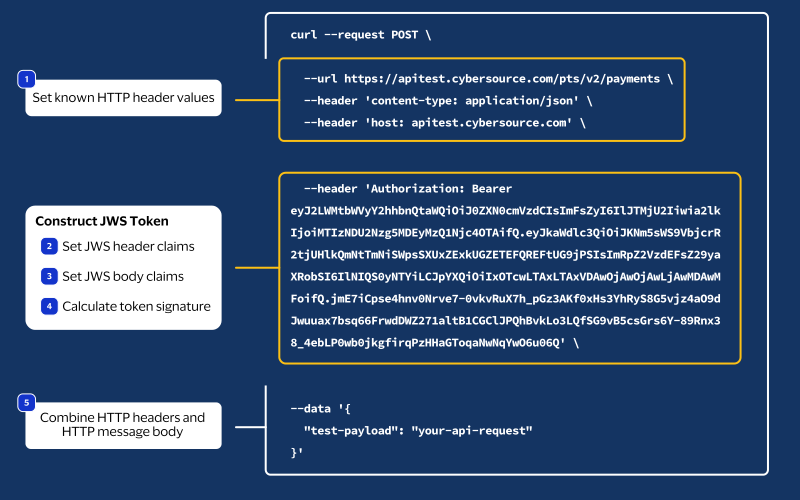
risk transaction failure if you do not update your system.To construct a message using JWTs, you must set the required HTTP headers, define the JWS
header and body claims, calculate the token signature, and combine these elements into a
request. This section describes how to create each element and construct the completed
JWT message in the following subsections.
Figure:
JWT Construction Steps
JSON Web Token Message Elements
A REST API request authenticated with a JWT consists of HTTP headers and an HTTP message
body.
- HTTP Message Elements
- Your HTTP message header must include these elements:
- HTTP Message Header ElementsHTTP Header ElementDescriptioncontent-typeThe media or file type of the request, which is also known as the Multipurpose Internet Mail Extension (MIME) type. Example:application/jsonhostThe transaction endpoint. Example:api.cybersource.comauthorizationThe JSON Web Signature (JWS) bearer token. Format:Bearer <JWS token>. Steps 3B–3D explain how to create this token.
- HTTP Message Body
- Your API request.
Step 3A: Set Known HTTP Headers
Set the values for these HTTP header elements. These header values do not require any
calculation.
- content-type
- Set to the media or file type resource.
- host
- Set to theCybersourceAPI endpoint.
The
authorization
header value is a JWS token. How you construct the
JWS token is described in Steps 3B – 3D. A JWS token consists of three segments
separated by the period character
(.
).<Base64URL-encoded JWS header>.<Base64URL-encoded JWS body claims>.<Base64URL-encoded signature>
Step 3B: Set the JWS Header Claims
This step begins the process of constructing a
JSON Web Signature
(JWS)
token. To construct a JWS token, you must first create the JWS header by setting its
header claim values. After creating the JWS header, use Base64URL to encode it. The
encoded header claim value is the first segment of the JWS token.These header claim values do not require calculation.
Header Field | Description |
|---|---|
alg | The asymmetric algorithm you use to sign the token header. These
algorithms are supported:
|
kid | The key ID you use to digitally sign the JWT. It must be
registered with the authorizing server. It is the key ID from your
P12 certificate. For more information, see Create or Submit a P12 Certificate. |
typ | The token type. Set to JWT . |
Step 3C: Set the JWS Body Claims
After you set the JWS header values, you must create the JWS body by setting
these body claim values. After the body claims are created, use Base64URL to encode
it. The encoded body claim value is the second segment of the JWS token.
JWS Body Claim Field | Description | Data Type | Field Value Format |
|---|---|---|---|
digest | A Base64-encoded hash of the message payload. Do not include the digest field if the request message
is empty, such as during a GET or DELETE request. | String | Base64-encoded string: uppercase, lowercase, digits,
+ , / , and optional
= padding |
digestAlgorithm | The algorithm used to hash the message payload. The message payload should be hashed using the SHA-256
algorithm. Do not include the digestAlgorithm field if the
digest field is not included. | String | Lowercase |
exp | The time at which the JWS token expires. IMPORTANT
Field values
cannot exceed two minutes after the message issue date,
which is the iat field value.This field is an HTTP-date value as defined in RFC7231. For
example, 01/01/2020 at 00:02:00 is
1577836920 . | String | Numeric |
iat | The date and time at which the message is issued. This field
uses a NumericDate value as defined in RFC 7519,
which is the number of seconds since
1970‑01‑01T00:00:00Z (Unix epoch).For example, 01/01/2020 at 00:00:00 is
1577836800 . | String | Numeric |
iss | The issuer identifier for the JWS token. Set to the merchant
ID that created the P12 certificate. This value is used to
validate the issuer. | String | Lowercase |
jti | The unique token ID. This value is used for replay
prevention. Format the value using UUID version 4. For example:
6643fb9a-8093-47c6-95d3-8d69785b5e62 | String | Lowercase alphanumeric |
request-host | The endpoint hostname for the HTTP request, excluding the
protocol and path. https://api.cybersource.com /pts/v2/paymentsapi.cybersource.com . | String | Lowercase alphanumeric with periods |
request-method | The HTTP request method. For example, post ,
get , put ,
patch , or delete . | String | Lowercase |
request-resource-path | The endpoint path for the HTTP request, excluding the
domain. For example, to send a message to the https://api.cybersource.com /pts/v2/payments/pts/v2/payments . | String | Lowercase alphanumeric |
v-c-jwt-version | The Visa JWT scheme version number. Set to
2 . | String | Numeric |
v-c-merchant-id | Your Cybersource transacting merchant ID
(MID).If you are a portfolio or merchant account user, set this to
the transacting merchant ID you send requests on behalf
of. | String | Lowercase alphanumeric |
v-c-response-mle-kid | The message-level encryption response key ID, also known as
the REST–API Response MLE key. | String | Lowercase alphanumeric |
The value of the
digest
JWS claim is a hashed version of the HTTP
message body that you must calculate. Cybersource
uses this hash
value to validate the integrity of your message body.Follow these steps to calculate the digest hash:
- Generate the SHA-256 hash of the JSON payload (message body).
- Encode the hashed string to Base64.
- Add the message body hash to thedigestJWS body claims.
- Add the algorithm used to hash the digest in thedigestAlgorithmJWS body claims.
Example: Creating a Message Hash Using the Command Line
shasum
Toolcat <<'EOF' | tr -d '\n' | shasum -a 256 { "clientReferenceInformation": { "code": "TC50171_3" }, "paymentInformation": { "card": { "number": "4111111111111111", "expirationMonth": "12", "expirationYear": "2031" } }, "orderInformation": { "amountDetails": { "totalAmount": "102.21", "currency": "USD" }, "billTo": { "firstName": "John", "lastName": "Doe", "address1": "1MarketSt", "locality": "sanfrancisco", "administrativeArea": "CA", "postalCode": "94105", "country": "US", "email": "", "phoneNumber": "4158880000" } } } EOF
Example: Creating a Message Hash Using the Command Line
base64
Toolecho -n "6ae5459bc8a7d6a4b203e8a734d6a616725134088e13261f5bbcefc1424fc956" | base64
Example: Creating a Message Hash Using C#
public static string GenerateDigest()
{
    var digest = "";
    var bodyText = "{ your JSON payload }";

    using (var sha256hash = SHA256.Create())
    {
        byte[] payloadBytes = sha256hash.ComputeHash(Encoding.UTF8.GetBytes(bodyText));
        digest = Convert.ToBase64String(payloadBytes);
    }

    return digest;
}
Example: Creating a Message Using Java
public static String GenerateDigest() throws NoSuchAlgorithmException {
    String bodyText = "{ your JSON payload }";

    MessageDigest md = MessageDigest.getInstance("SHA-256");
    md.update(bodyText.getBytes(StandardCharsets.UTF_8));
    byte[] digest = md.digest();

    return Base64.getEncoder().encodeToString(digest);
}
Step 3D: Calculate the JWS Signature
You can now calculate the JSON Web Signature (JWS). The JWS consists of the JWS header and
claim set hashes in the following format. They are encrypted with the private key.
[JWS Header].[Claim Set]
Follow these steps to calculate the signature:
- Concatenate the JWS header and claim set hash strings with a period character (.) between the hashes:[JWS Header].[Claim Set]
- Generate an encoded version of the text file using your private key from the.p12certificate. For more information, see Create or Submit a P12 Certificate.
- Base64-encode the signature output.
- After calculating the signature, you can construct a complete JWS token by combining the JWS header claims, body claims, and signature.
Example: Token Signature Hash
YjgwNGIxOTMxMzQ2NzhlYjdiMDdhMWZmYjZiYzUzNzliMTk5NzFmNjAzNWRmMThlNzk0N2NhY2U0YTEwNzYyYQ
Code Example: Encoding the Signature File Using OpenSSL
Encode the signature file using the
openssl
tool.openssl rsautl -encrypt -inkey publickey.key -pubin -in [signature-text-file] > [signature-encoded-file]
Code Example: Base64 Encoding the Signature File Using the Command
Line
Encode the signature file using the
openssl
tool and remove any
padding.base64 -i [signature-encoded-file]
- Result
- The result of this step is the encoded signature, which is the third segment of the JWS token. You have now created all three segments of the JWS token. The completed JWS token is the HTTPauthorizationheader value.
- <Base64URL-encoded JWS Header>.<Base64URL-encoded JWS Body Claims>.<Base64URL-encoded Signature>
Step 3E: Complete the Message with JWTs
Combine the completed JWS token from Steps 3B–3D with the other HTTP headers from Step 3A and
your HTTP message body to construct your authenticated REST request message:
Host: api.cybersource.com
Content-Type: application/json
Authorization: Bearer <Base64URL-encoded JWS header>.<Base64URL-encoded JWS body claims>.<Base64URL-encoded signature>

{
  "clientReferenceInformation": {
    "code": "refnum-123456"
  },
  "paymentInformation": {
    "card": {
      "number": "411111111111XXXX",
      "expirationMonth": "12",
      "expirationYear": "2031"
    }
  }
}
Enable Message-Level Encryption
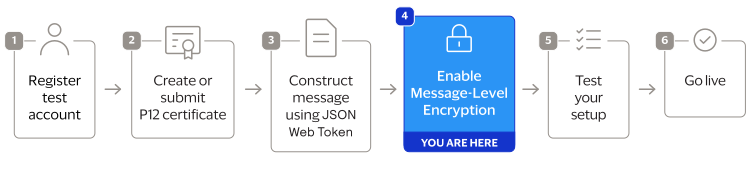
IMPORTANT
There are additional tasks you must complete before you can
enable message-level encryption. See the Prerequisites for MLE section below.
Message-Level Encryption (MLE) enables you to store information or communicate
with other parties while helping to prevent uninvolved parties from understanding the
stored information. Enabling MLE requires you to create or submit a
P12
Certificate
for encrypting your requests and a REST – API Response MLE
key for decrypting received responses. If your organization is using meta keys, the
P12 Certificate
and REST – API Response MLE
must be created by the
same portfolio or merchant account.This section explains how to enable MLE with JWT messaging.
Prerequisites for MLE
Before you can set up message-level encryption (MLE), you must complete these
requirements:
- Verify that your system is configured to read the public key and encrypt the API payload.
- Verify that you have a P12 certificate and extracted its private key. For more information, see Create or Submit a P12 Certificate.
- Verify that your system can construct JWTs. For more information, see Construct Messages Using JSON Web Tokens.WARNINGAs ofFebruary 2026, there are new requirements for constructing a JWT. ByMarch 2027, merchants must update their system to support the new JWT construction. Merchants who do not update their system to support this requirement risk transaction failure.
Step 4A: Create or Submit a REST—API Response MLE
Key
Before you can enable your system to support MLE, you must create or upload
a
REST—API response MLE
certificate. After creating or uploading the certificate,
you can extract the certificate's key to begin enabling MLE. If your organization is
using meta keys, the P12 certificate
and REST – API response MLE
key must
be created by the same portfolio or merchant account.Follow these steps to create or submit an API Response MLE certificate in
the
Business Center
:- Log in to theBusiness Center:
- On the left navigation panel, choose
Payment Configuration > Key Management.
- Click+ Generate keyon the Key Management page.
- Under REST APIs, chooseREST – API Response MLE, and then clickGenerate key.
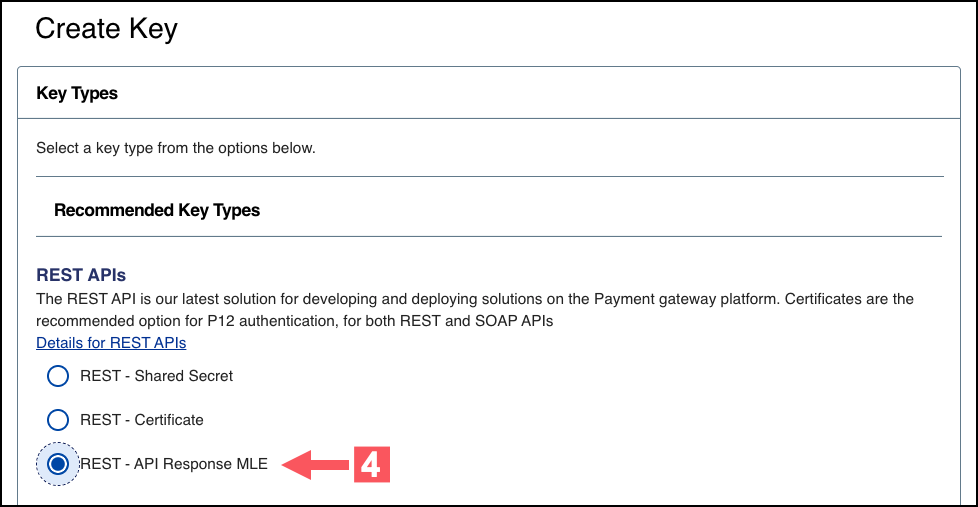
- Choose one of these options to download your key:
- To create a new API response MLE certificate, clickDownload key
.
- To upload your own certificate, enter your public PEM-formatted certificate in the text box, and then clickDownload key
. The
.pemfile downloads to your desktop. If prompted by your system, approve the location to which the file downloads.
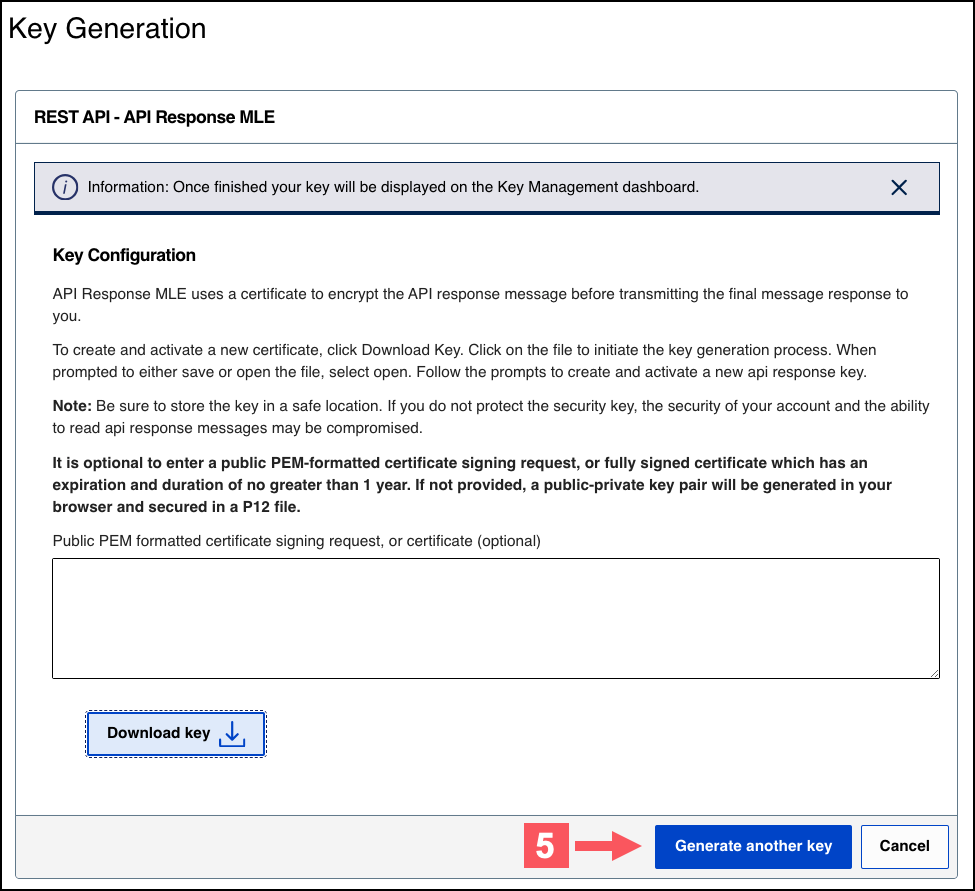
- If you are creating a certificate, the Set a Password window appears. Create a password for the certificate by entering the password into theNew PasswordandConfirm Passwordfields, and then clickGenerate key.The.p12file downloads to your desktop. If prompted by your system, approve the location to which the key downloads.
To create or submit another key, clickGenerate another key. To view all of your created keys, go to the Key Management page.IMPORTANTSecurely store the.p12file and password in your system. These credentials are required in order to implement certain products, and you must be able to access them.
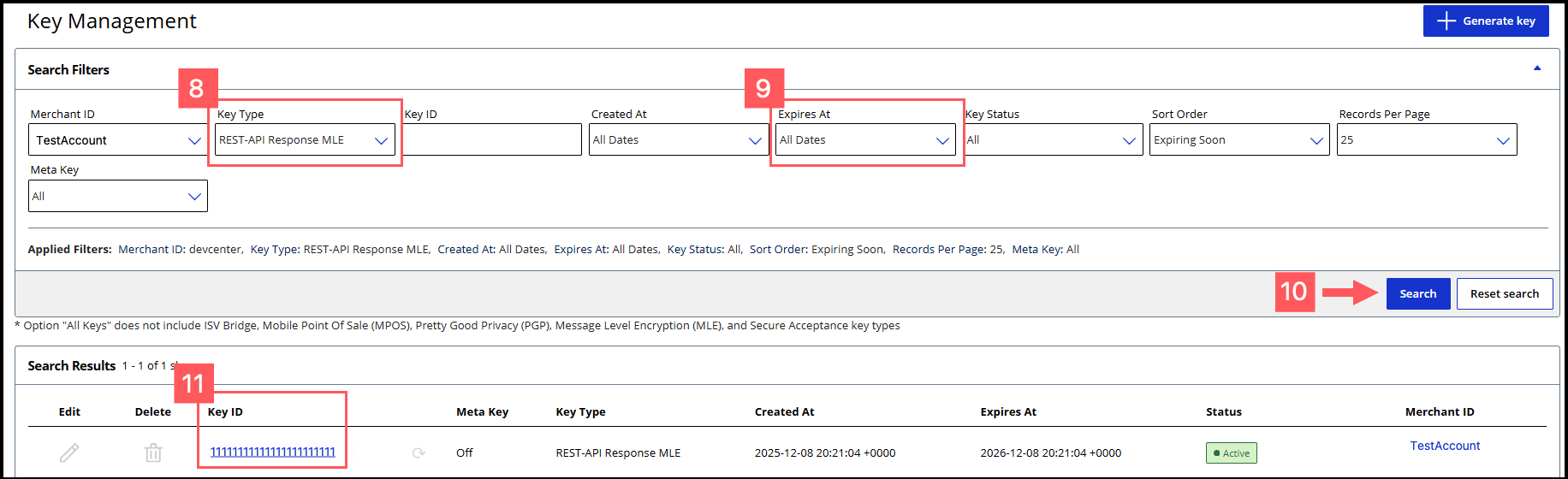
- ClickCancel.The Key Management page appears.
- Click theKey Typefilter and chooseREST-API Response MLE.
- Click theExpires Atfilter and chooseAll Dates.
- ClickSearch.
- Find the REST–API Response key that you created in the Search Results table and save its key ID.The key ID is needed to test and configure your system to use MLE.
- Test Your REST–API Response MLE Key
- To test your REST–API Response key, see Test Your REST—API Response MLE Key.
Step 4B: Extract the SJC Certificate
The REST–API Response MLE Key contains an SJC certificate that you must extract in
order to enable MLE.
Follow these steps to extract the SJC certificate from your REST–API Response MLE
Key:
- Open and use a terminal window to navigate to the REST–API Response MLE Key.p12file in your system.
- Run this command to open the.p12file:openssl pkcs12 -in {certificate_file_name}.p12You are prompted to enter the import password.
- Enter the password you set when you created the REST–API Response MLE Key.
- Locate theCyberSource_SJC_UScertificate in the opened file. This is the SJC certificate.
- Store the SJC certificate in your system to use when you enable MLE.
Step 4C: Set Up MLE
Use the information in this section to configure your system with a custom MLE using
JWTs.
If you do not want to set up a custom MLE, you can use the REST Client SDK
instead. For more information, see the REST Client SDKs in GitHub.
Figure:
Overview of MLE Set-Up Tasks
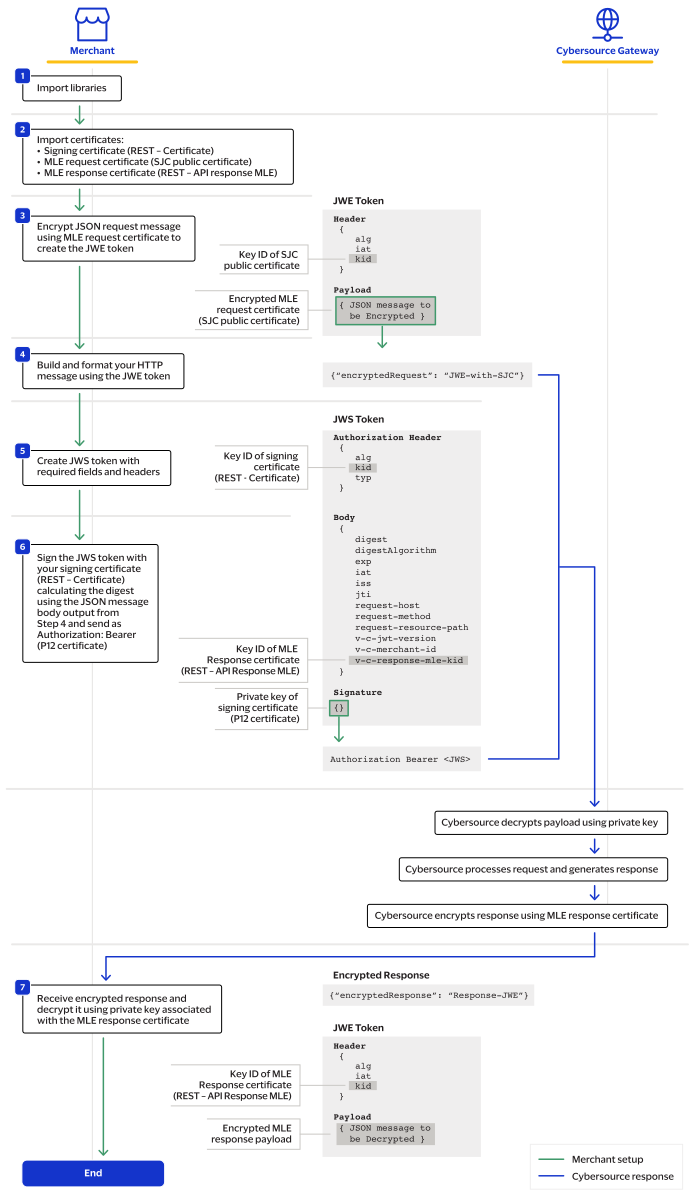
- Import the required programming libraries for your system.
- Import these three certificates:
- Signing certificate (P12 Certificate or REST – Certificate).
- MLE request certificate (SJC public certificate)
- MLE response certificate (REST – API Response MLE)
- Encrypt the JSON request message using a JSON Web Encryption (JWE) that uses the SJC public certificate.
- Create the HTTP body in this format:{"encryptedRequest": ".JWE-with-SJC"}
- Create the JSON Web Signature (JWS) payload with these JWT payload fields and your signing certificate's private key. For descriptions of these fields, see the Headers table and Message Body Fields table in Construct Messages Using JSON Web Tokens.
- Header Fields
- alg
- kid
- type
- Message Body Fields
- digestAlgorithm
- digestof the HTTP body
- exp
- iat
- iss
- jti
- request-host
- request-method
- request-resource-path
- v-c-jwt-version
- v-c-merchant-id
- v-c-response-mle-kidfrom the MLE response certificate.
- Sign the JWS with your P12 certificate and send it asAuthorization: Bearer.
- Receive an encrypted response and decrypt it with the MLE private key. You will receive the response in this format:{"encryptedResponse": "JWE-with-ResponseMLECertificate"}The JWE contains a JOSE header containing these four default elements:"alg": "RSA-OAEP-256", // The algorithm used to encrypt the CEK. "enc": "A256GCM", // The algorithm used to encrypt the message. "iat": "1702493653", // The current timestamp in milliseconds. "kid": "keyId" // The serial number of the v-c-response-mle-kid from the authentication JWS in step 5.
Java Example: Enabling MLE Using JWTs
This setup example describes the general requirements to configure your system to
support MLE. How you enable MLE in your system can defer from the example code below
due to your specific system environment. These example steps use the Java
programming
language.
- Import your preferred libraries to support MLE. In this step, the configuration uses Java leveraging the open source Nimbus JOSE and Bouncy Castle libraries.// Nimbus JOSE + JWT import com.nimbusds.jose.JWEAlgorithm; import com.nimbusds.jose.JWEHeader; import com.nimbusds.jose.JWEObject; import com.nimbusds.jose.JWSAlgorithm; import com.nimbusds.jose.JWSHeader; import com.nimbusds.jose.JWSObject; import com.nimbusds.jose.JOSEObjectType; import com.nimbusds.jose.EncryptionMethod; import com.nimbusds.jose.Payload; import com.nimbusds.jose.crypto.RSADecrypter; import com.nimbusds.jose.crypto.RSAEncrypter; import com.nimbusds.jose.crypto.RSASSASigner; // BouncyCastle (PEM parsing + cert conversion) import org.bouncycastle.cert.X509CertificateHolder; import org.bouncycastle.cert.jcajce.JcaX509CertificateConverter; import org.bouncycastle.openssl.PEMKeyPair; import org.bouncycastle.openssl.PEMParser; import org.bouncycastle.openssl.jcajce.JcaPEMKeyConverter;
- Import the signing, MLE, and SJC certificates. The P12 certificate as the signing certificate.public final class KeyPairMaterial { public final PrivateKey privateKey; public final X509Certificate cert; public KeyPairMaterial(PrivateKey k, X509Certificate c) { this.privateKey = k; this.cert = c; } } public final class CryptoMaterialDual { // Merchant: JWS (REST – Certificate) public final KeyPairMaterial signingCert; // Merchant: Response decryption (API Response MLE) public final KeyPairMaterial responseCert; // Platform encryption cert (SJC) public final X509Certificate sjcCert; public CryptoMaterialDual(KeyPairMaterial signingCert, KeyPairMaterial responseCert, X509Certificate sjcCert) { this.signingCert = signingCert; this.responseCert = responseCert; this.sjcCert = sjcCert; } }
- Unpack your imported certificates into a usable format for your system.Create this method for your system to read your.p12file, if you are using the P12 certificate.static KeyPairMaterial loadKeyPairFromP12(Path p12Path, char[] password, String keyAlias) throws Exception { KeyStore ks = KeyStore.getInstance("PKCS12"); try (InputStream in = Files.newInputStream(p12Path)) { ks.load( in , password); } KeyStore.PrivateKeyEntry entry = (KeyStore.PrivateKeyEntry) ks.getEntry( keyAlias, new KeyStore.PasswordProtection(password)); return new KeyPairMaterial(entry.getPrivateKey(), (X509Certificate) entry.getCertificate()); }Create this method for your system to read the PEM chain and private key.static KeyPairMaterial loadKeyPairFromPem(Path certificateChainPem, String privateKeyPem) throws Exception { X509Certificate leaf = readPemCerts(certificateChainPem).get(0); PrivateKey key = readPkcs8PrivateKey(privateKeyPem); return new KeyPairMaterial(key, leaf); }Create this method for your system to read the SJC from the.p12file or PEM chain.static X509Certificate loadSjcFromP12(Path p12Path, char[] password, String sjcAlias) throws Exception { KeyStore ks = KeyStore.getInstance("PKCS12"); try (InputStream in = Files.newInputStream(p12Path)) { ks.load( in , password); } return (X509Certificate) ks.getCertificate(sjcAlias); } static X509Certificate loadSjcFromPem(Path sjcCertPem) throws Exception { return readPemCerts(sjcCertPem).get(0); }Create this method to include PEM helper functions.static List < X509Certificate > readPemCerts(Path pemPath) throws Exception { try (Reader r = Files.newBufferedReader(pemPath); org.bouncycastle.openssl.PEMParser p = new org.bouncycastle.openssl.PEMParser(r)) { var xconv = new org.bouncycastle.cert.jcajce.JcaX509CertificateConverter().setProvider("BC"); List < X509Certificate > certs = new ArrayList < > (); Object o; while ((o = p.readObject()) != null) { if (o instanceof org.bouncycastle.cert.X509CertificateHolder h) certs.add(xconv.getCertificate(h)); } return certs; } } static PrivateKey readPkcs8PrivateKey(String pem) throws Exception { try (var parser = new org.bouncycastle.openssl.PEMParser(new StringReader(pem))) { Object o = parser.readObject(); var conv = new org.bouncycastle.openssl.jcajce.JcaPEMKeyConverter().setProvider("BC"); if (o instanceof org.bouncycastle.asn1.pkcs.PrivateKeyInfo pki) return conv.getPrivateKey(pki); if (o instanceof org.bouncycastle.openssl.PEMKeyPair kp) return conv.getPrivateKey(kp.getPrivateKeyInfo()); throw new IllegalArgumentException("Expect PKCS#8 private key PEM"); } }
- Create these methods as helpers for encrypting and signing.static String kidFromCert(X509Certificate cert) { String dn = cert.getSubjectDN().getName().toUpperCase(); int i = dn.indexOf("SERIALNUMBER="); if (i >= 0) { int j = dn.indexOf(",", i); if (j < 0) j = dn.length(); return dn.substring(i + "SERIALNUMBER=".length(), j).trim(); } return cert.getSerialNumber().toString(); } static String encryptToJwe(String json, X509Certificate sjcCert) throws Exception { var header = new com.nimbusds.jose.JWEHeader.Builder( com.nimbusds.jose.JWEAlgorithm.RSA_OAEP, com.nimbusds.jose.EncryptionMethod.A256GCM) .contentType("JWT") .keyID(kidFromCert(sjcCert)) .build(); var jwe = new com.nimbusds.jose.JWEObject(header, new com.nimbusds.jose.Payload(json)); jwe.encrypt(new com.nimbusds.jose.crypto.RSAEncrypter((RSAPublicKey) sjcCert.getPublicKey())); return jwe.serialize(); } static String sha256Base64(String body) throws Exception { MessageDigest md = MessageDigest.getInstance("SHA-256"); return Base64.getEncoder().encodeToString(md.digest(body.getBytes(StandardCharsets.UTF_8))); } static String signAsJws(String payload, KeyPairMaterial signingCert) throws Exception { var header = new com.nimbusds.jose.JWSHeader.Builder(com.nimbusds.jose.JWSAlgorithm.RS256) .keyID(kidFromCert(signingCert.cert)) .type(com.nimbusds.jose.JOSEObjectType.JWT) // typ=JWT .build(); var jws = new com.nimbusds.jose.JWSObject(header, new com.nimbusds.jose.Payload(payload)); jws.sign(new com.nimbusds.jose.crypto.RSASSASigner(signingCert.privateKey)); return jws.serialize(); } static String decryptJwe(String compactJwe, KeyPairMaterial responseCert) throws Exception { var jwe = com.nimbusds.jose.JWEObject.parse(compactJwe); jwe.decrypt(new com.nimbusds.jose.crypto.RSADecrypter((RSAPrivateKey) responseCert.privateKey)); return jwe.getPayload().toString(); }
- Create a class that uses the methods described in the above steps to encrypt and decrypt your payloads with MLE using JWTs.// Example mix: // - REST – Certificate from PKCS#12 // - API Response MLE from PEM // - SJC from PEM KeyPairMaterial signingCert = loadKeyPairFromP12( Paths.get("merchant.p12"), "password".toCharArray(), "merchant"); KeyPairMaterial responseCert = loadKeyPairFromPem( Paths.get("api_response_mle_chain.pem"), Files.readString(Paths.get("api_response_mle_private_key.pem"))); X509Certificate sjc = loadSjcFromPem(Paths.get("sjc_certificate.pem")); CryptoMaterialDual mat = new CryptoMaterialDual(signingCert, responseCert, sjc); // 1) Build your request JSON String requestJson = new org.json.JSONObject() .put("amount", "10.00") .put("currency", "USD") .put("reference", "ORDER-12345") .toString(); // 2) Encrypt request body to JWE using SJC public cert String encryptedJwe = encryptToJwe(requestJson, mat.sjcCert); // 3) Build the HTTP body (this is what you’ll hash for the digest) String httpBody = new org.json.JSONObject() .put("encryptedRequest", encryptedJwe) .toString(); // 4) Build JWS payload: include iat, response kid, digestAlgorithm, and digest of httpBody String digestB64 = sha256Base64(httpBody); String jwsPayload = new org.json.JSONObject() .put("iat", java.time.Instant.now().getEpochSecond()) .put("v-c-response-mle-kid", kidFromCert(mat.responseCert.cert)) // instruct server to encrypt to your API Response MLE key .put("digestAlgorithm", "SHA-256") .put("digest", digestB64) .toString(); // 5) Sign the JWS with the REST – Certificate private key String signedJws = signAsJws(jwsPayload, mat.signingCert); // 6) Send the HTTP request // POST /your/api // Content-Type: application/json // Authorization: Bearer <signedJws> /* Body: { "encryptedRequest": "<encryptedJwe>" } */ // 7) Handle the response (decrypt if needed with API Response MLE private key) String apiResponse = /* http call result as string */; org.json.JSONObject resp = new org.json.JSONObject(apiResponse); String finalPayload = resp.has("encryptedResponse") ? decryptJwe(resp.getString("encryptedResponse"), mat.responseCert) : apiResponse;
Test Your Setup
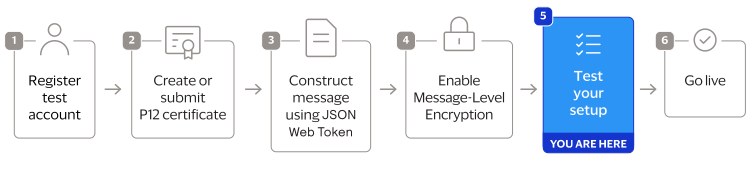
Cybersource
recommends that you test and verify
that your payment system can securely send and receive REST API messages before
transitioning to a production account. Use the test examples provided in this section to
test your set up. You should also test any additional API requests that you will use in
your live environment. Troubleshooting Using the REST SDK
You can also use the REST Client SDK to review how the SDK constructs, sends and
receives JWT messages with MLE. If you are receiving unsuccessful responses from
your custom integration, comparing how your system sends and receives messages to
the REST SDK can be helpful. For more information about how to install the REST
Client SDK into your system, see the Install the REST SDK
section.
Test Your REST—API Response MLE Key
Follow these steps to verify that your API response MLE key is working. If you
have not already created or submitted an API response MLE certificate, see the Create or
Submit a REST—API Response MLE Key section in Enable Message-Level Encryption.
- Go to the REST API Reference page in theCybersourceDeveloper Center:
- On the left navigation panel, choose an API that supports MLE. For testing purposes, you can chooseIntelligent Commerce > Intelligent Commerce Product > Enroll a Card.MLE support is indicated byRequest MLEandResponse MLEat the top of the screen.

- Choose theMLE Configurationtab.
- In the Message Level Encryption Credentials section, enter your API response MLE key credentials:
- Response encryption:Enter the key ID of your REST—API response MLE key.You saved this key ID in Step 10 in the Create or Submit a REST—API Response MLE Key section in Enable Message-Level Encryption.
- Response decryption:ClickBrowseto submit your own private decryption key from your local system. Only.p12files are supported.
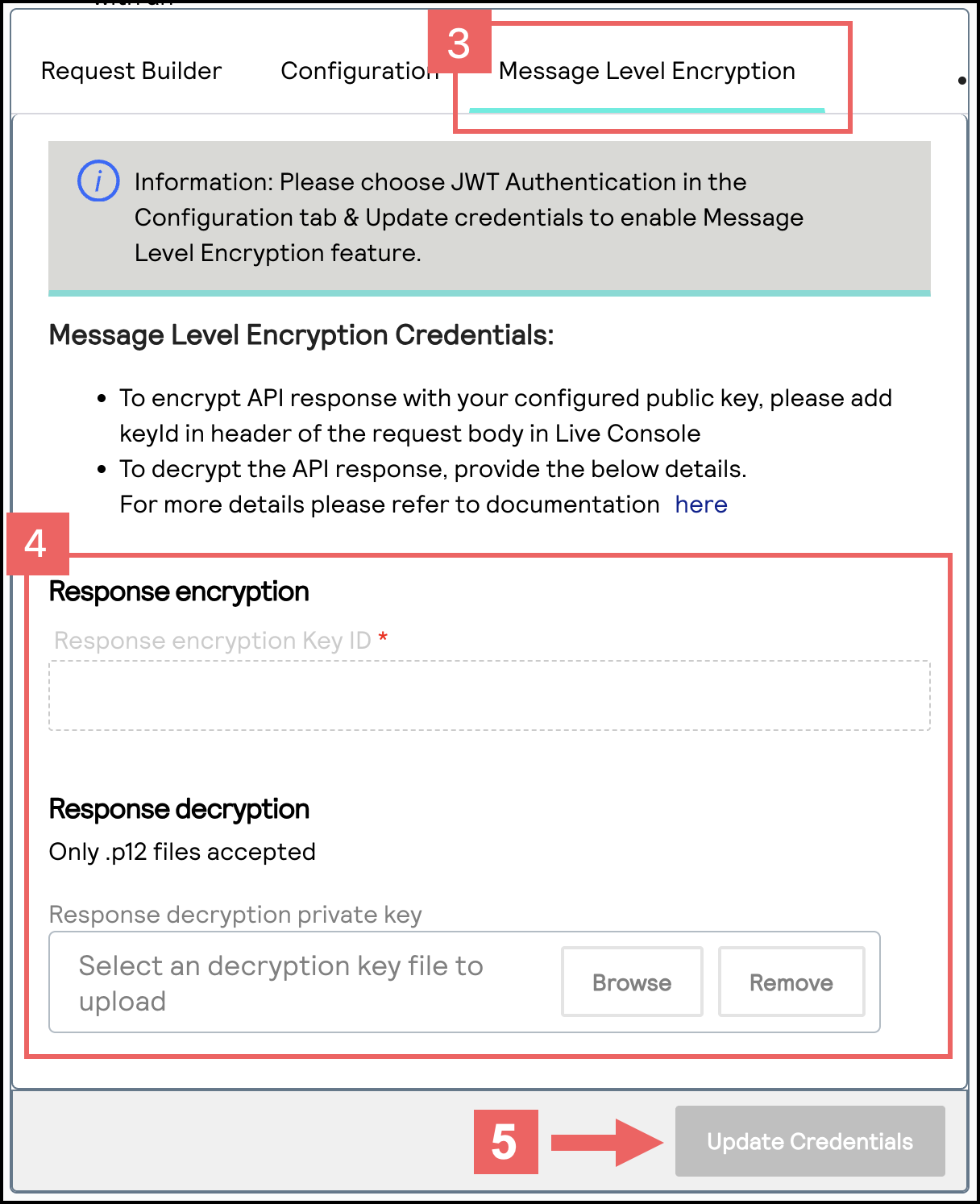
- ClickUpdate Credentials.
- From theSenddrop-down menu, chooseSend Request with Message Level Encryption.
- ClickSend.
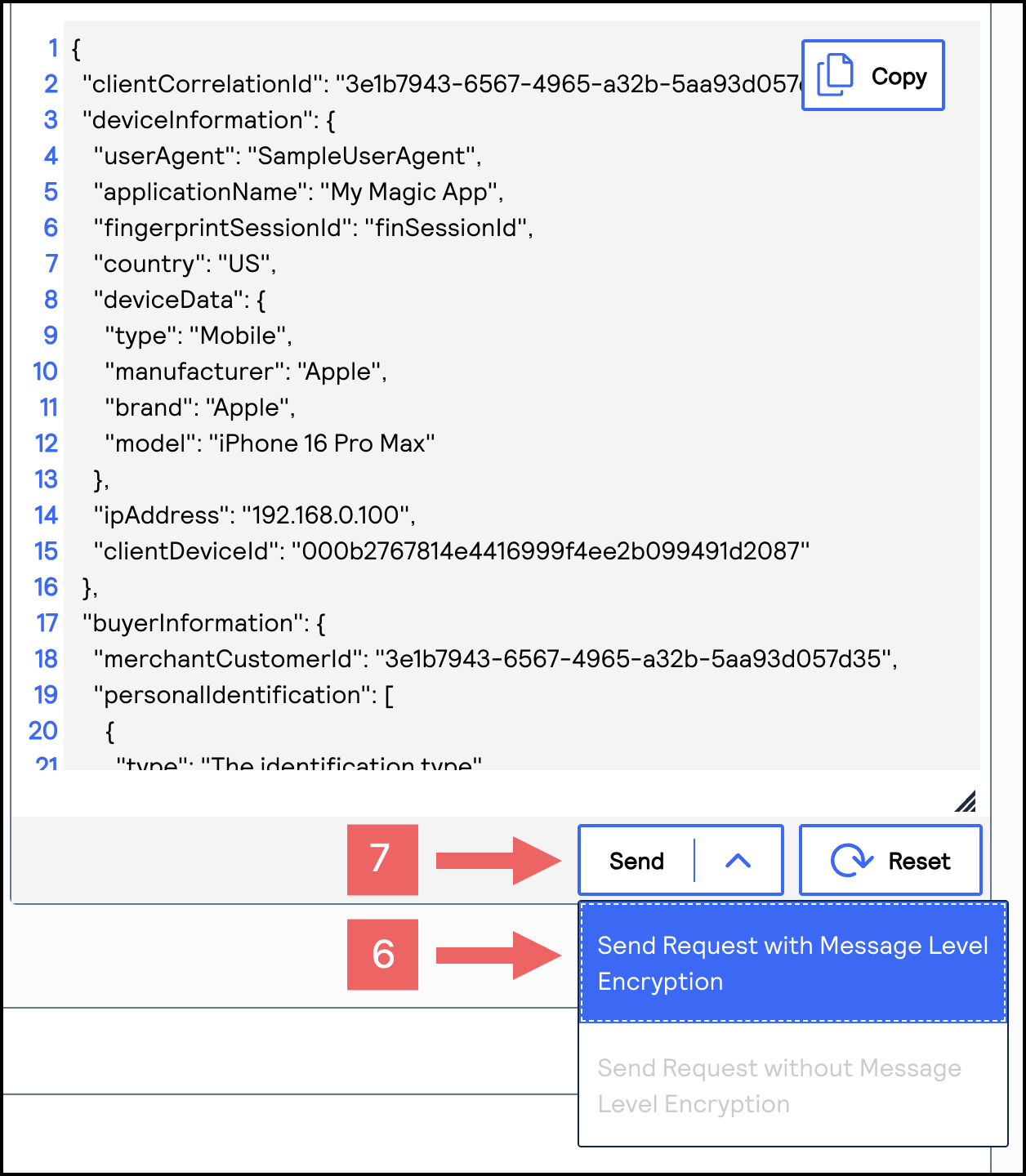
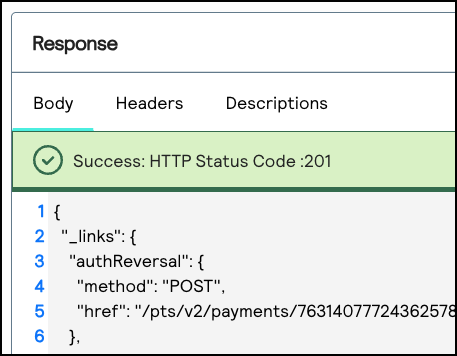
- If aSuccess: HTTP Status Code: 201message displays in the Response section, your REST—API response MLE key is verified as properly configured.
Completing a Test Transaction
After setting up your system to be REST compliant, you can send these test requests
to verify that you can send and receive REST API messages.
IMPORTANT
Depending on your payment processor, you may be required to send additional
fields that are not shown in these examples.
Follow these steps to verify that you can complete a test transaction:
- Authorize a Payment
- You send this POST request to theendpoint:https://apitest.cybersource.com/pts/v2/payments{ "orderInformation": { "billTo": { "country": "US", "lastName": "Kim", "address1": "201 S. Division St.", "postalCode": "48104-2201", "locality": "Ann Arbor", "administrativeArea": "MI", "firstName": "Kyong-Jin", "email": "" }, "amountDetails": { "totalAmount": "100.00", "currency": "USD" } }, "paymentInformation": { "card": { "expirationYear": "2031", "number": "4111111111111111", "expirationMonth": "12", "type": "001" } } }
- You receive a successful response and store the authorization transaction ID in theidfield. A successful response is indicated by a 201 HTTP status code."id" : "6461731521426399003473"
- Capture an Authorized Payment
- You send this POST request to theendpoint and include the authorization transaction ID as thehttps://apitest.cybersource.com/pts/v2/payments/{id}/captures:{id}https://apitest.cybersource.com/pts/v2/payments/6461731521426399003473/captures{ "clientReferenceInformation": { "code": "ABC123" }, "orderInformation": { "amountDetails": { "totalAmount": "100.00", "currency": "USD" } }
- You receive a successful response and store the capture transaction ID in theidfield. A successful response is indicated by a 201 HTTP status code."id": "6772994431376681303954"
- Refund a Captured Payment
- You send this POST request to theendpoint and include the capture transaction ID as thehttps://apitest.cybersource.com/pts/v2/payments/{id}/refunds:{id}https://apitest.cybersource.com/pts/v2/payments/6772994431376681303954/refunds{ "orderInformation": { "amountDetails": { "totalAmount": "100.00", "currency": "USD" } } }
- You receive a successful response, which verifies that your system can complete a transaction. A successful response is indicated by a 201 HTTP status code.
Going Live
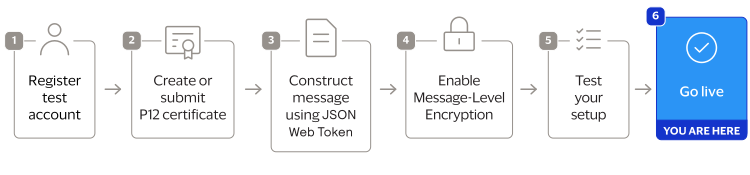
When you are ready to process payments in a live environment, you must
transition your account to the live status with a valid configuration for your chosen
payment processor. When your account is live, your transaction data flows through the
production
Cybersource
gateway, to your processor, and on to the
appropriate payment network.To transition your account:
- Sign up for a merchant account.
- to establish a contract withCybersourcethat enables you to process real transactions and receive support.
- Submit a merchant ID (MID) activation request.
It can take up to three business days for the MID to become active.
Step 6A: Create a Merchant ID
Your merchant ID (MID) identifies you and your transactions, which requires
you to include it in each transaction request. When you signed up for a sandbox account,
you received a merchant ID for testing purposes. If you choose, you can use that
merchant ID as your production ID.
Follow these steps to sign up for a merchant account in order to create a production MID:
- Go to theBusiness CenterSandbox Account Sign Up page, enter the required information, and clickCreate Account.Choose your merchant ID name. It cannot be changed. This name is not visible to your customers.
- Review your information entered, especially your business email address. Your merchant ID registration information will be sent to the email entered on this form.
- Look for an email from customer support titled:.CybersourceMerchant Evaluation AccountThis email contains your organization ID and contact email associated with your MID.
- Look for an email titled:Merchant Registration Details. Click theSet up your username and password nowlink.Your browser opens the New User Sign Up wizard.
- Enter the organization ID and contact email you supplied previously. Follow the wizard pages to add your name, a username, and password.
- Log in to theBusiness Center.When you log in for the first time, you will be asked to identify yourself through a system-generated email that is sent to your email account.
- Look for an email titled:. Save the passcode in the email.CybersourceIdentification Code
- Enter the passcode on the Verify your Identity page. You are directed to theBusiness Centerhome page.
You have successfully created a merchant ID and merchant account.
Step 6B: Activate Your Merchant ID
The activation process, also known as
going live
, transitions your
MID and account from test status to live status, enabling you to process real
transactions. It can take up to three business days for your MID to become active.To transition your account, complete these steps:
- Sign in to the Support Center as an administrator.
- Enter your credentials and log in to your test environment. The organization ID is your MID.
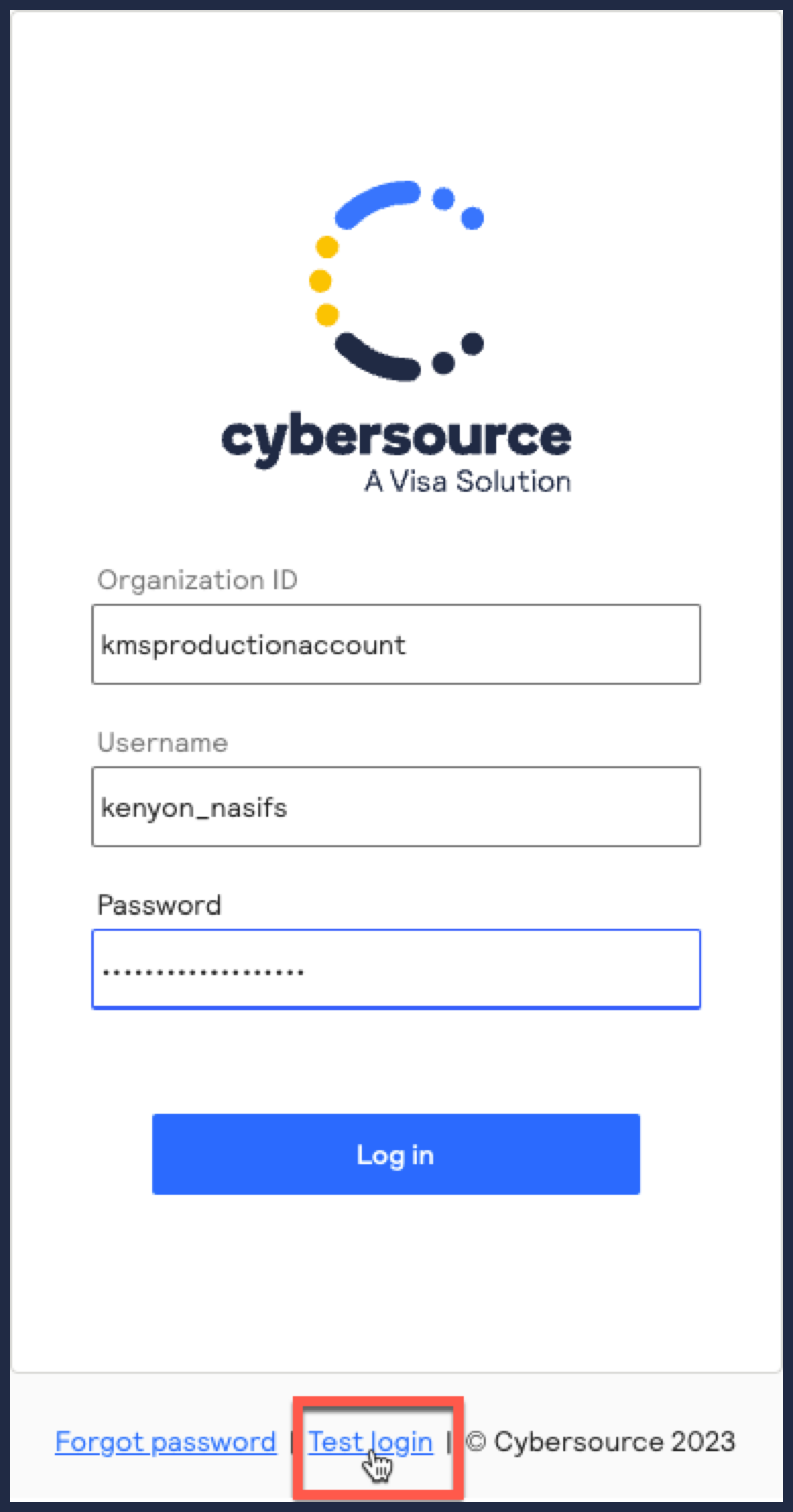
- In theBusiness Center, go toSupport Cases > MID Configuration Request. The MID Configuration Request page should be open.
- ClickMID Activation.
- In theDescriptionfield, enter the merchant ID that you want to take live.
- Choose a processor configuration, and enter the name of your processor.If you are unsure of the processor name, contact your merchant service provider or your merchant acquiring bank.
- Choose the environments to which this change applies (test or production).
- ClickService Enablementand list the products and services that you intend to use.
- ClickSubmit.
Production Endpoints
Send API requests using your production account to the production server:
https://api.cybersource.com
For example, send a live authorization request to this endpoint:
https://api.cybersource.com
/pts/v2/paymentsSet Up a JSON Web Token Message Using Shared Secret Key
Pairs
IMPORTANT
If you are using HTTP signature security for messaging, use this section to
migrate your system to support JSON Web Token messaging. By
March 2027
, all merchants using HTTP signature messaging must migrate to JSON
Web Token (JWT) messaging in order to support message-level encryption
(MLE).To set up JSON Web Token messaging using a
shared secret key pair
, you must
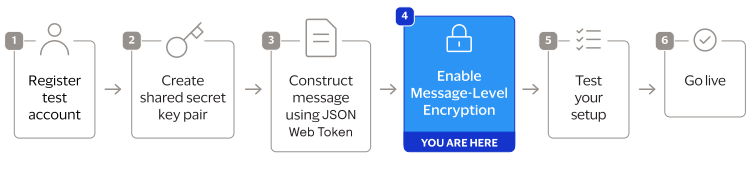
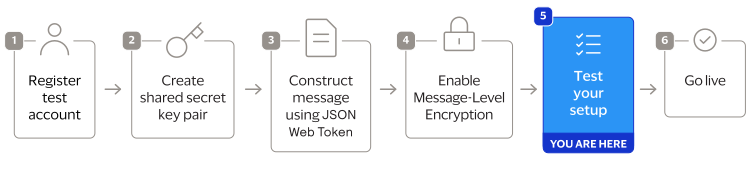
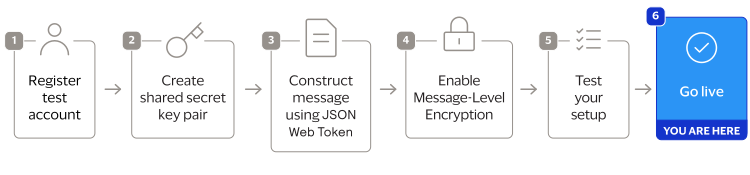
complete the tasks described in this section.Figure:
Set Up JSON Web Token a Messaging
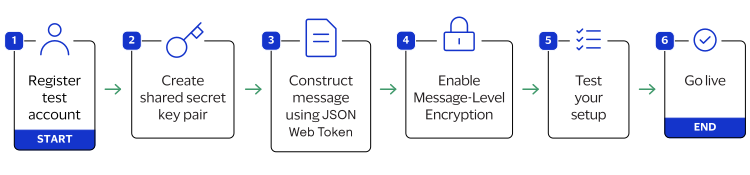
- Sign up for a test account. See Sign Up for a Test Account.
- Create a shared secret key pair. See Create a Shared Secret Key Pair.
- Construct a message using a JSON web token. See Construct Messages Using JSON Web Tokens.
- Enable message-level encryption (MLE) to encrypt all messages. See Enable Message-Level Encryption.
- Test your REST transaction messages. See Test Your Setup.
- Go live by transitioning your sandbox account into a production account. See Going Live.
Sign Up for a Test Account
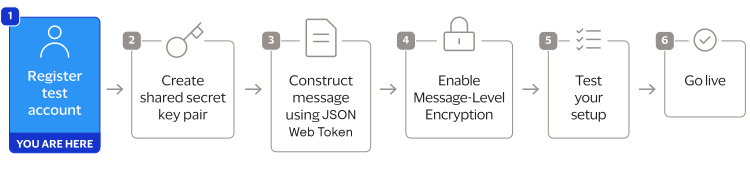
To begin setting up your account, you must first sign up for a sandbox test account. A test
account enables you to obtain your security keys and test your implementation.
IMPORTANT
A test account cannot process live payments and is intended for only testing.
Create a Shared Secret Key Pair
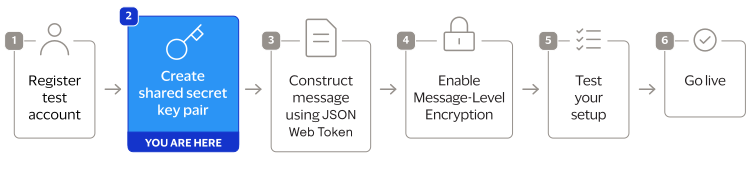
This section describes how to create a shared secret key pair and test that it works. A
shared secret key pair consists of a
key ID
and a shared secret key
, which
you must have in order to construct JWT messages and enable MLE.Step 2A: Create a Shared Secret Key Pair
- On the left navigation panel, choose
Payment Configuration > Key Management.
- Click+ Generate keyon the Key Management page.
- Under REST APIs, chooseREST – Shared Secretand then clickGenerate key.
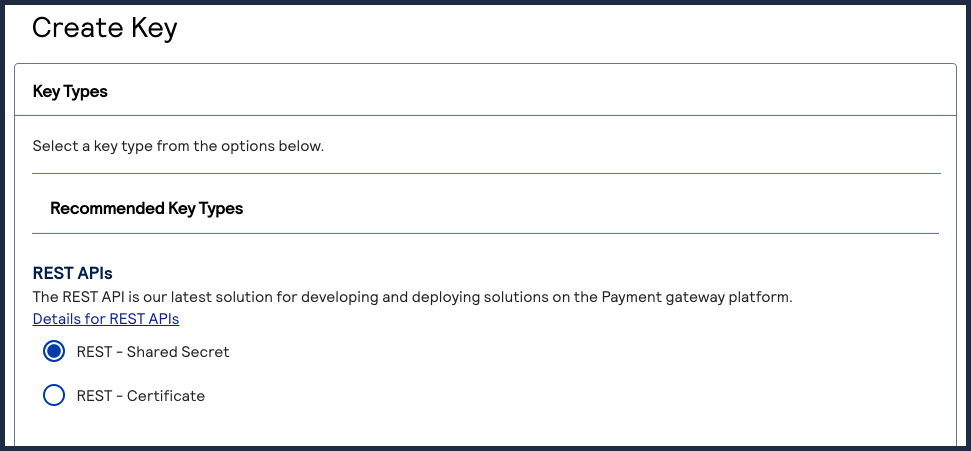
 The REST API Shared Secret Key page appears.
 - ClickGenerate keyafter reviewing the key details.
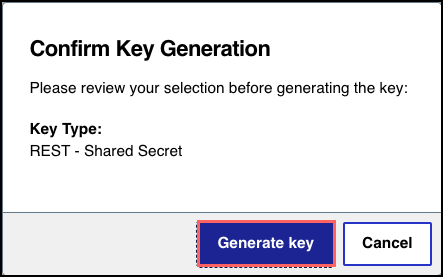
- ClickDownload key
.The.pemfile downloads to your desktop.
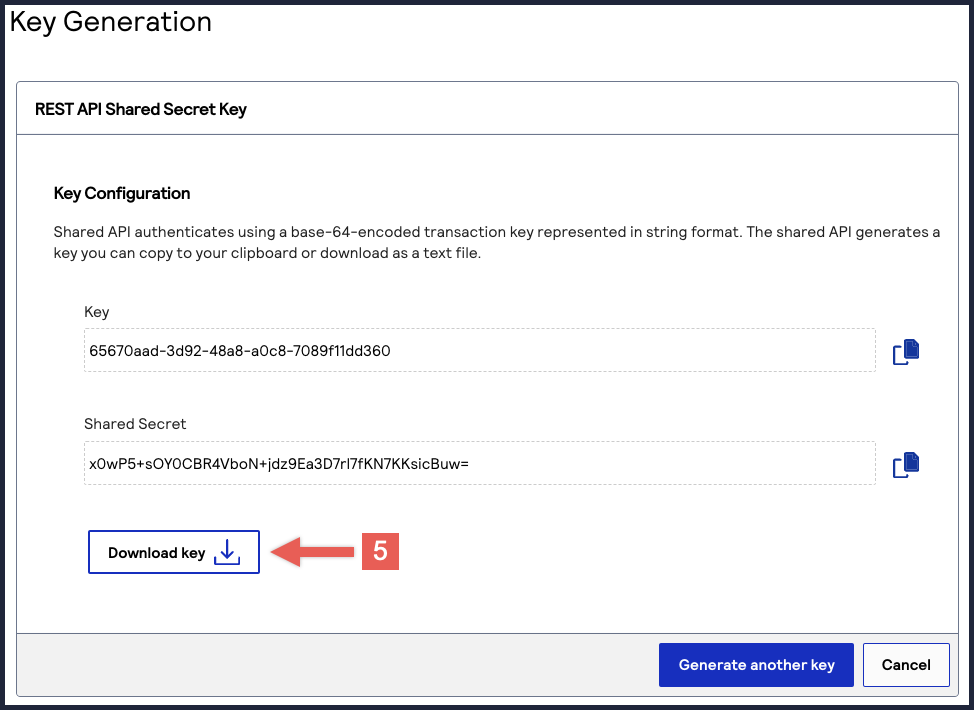 TheKeyvalue is yourkey IDand theShared Secretvalue is yourshared secret key.IMPORTANTSecurely store the key credentials and.pemfile in your system. These credentials are required in order to implement certain products, and you must be able to access them.
- What to do next
- To test your shared secret key pair, see Step 2B: Test Your Shared Secret Key Pair.
Step 2B: Test Your Shared Secret Key Pair
After creating your shared secret key pair, you must verify that your key pair can
successfully process API requests. Follow these steps to validate your key pair in
the Developer Center and the
Business Center
.- Go to the Developer Center's API Reference page:
- On the left navigation panel, click .
- Under Authentication and Sandbox Credentials, go to the Authentication Type drop-down menu and chooseHTTP Signature.
- Enter your organization ID in theOrganization IDfield.
- Enter your key ID in theKeyfield.
- Enter your shared secret key in theShared Secret Keyfield.
- ClickUpdate Credentials.A confirmation message displays stating that your credentials are successfully updated.
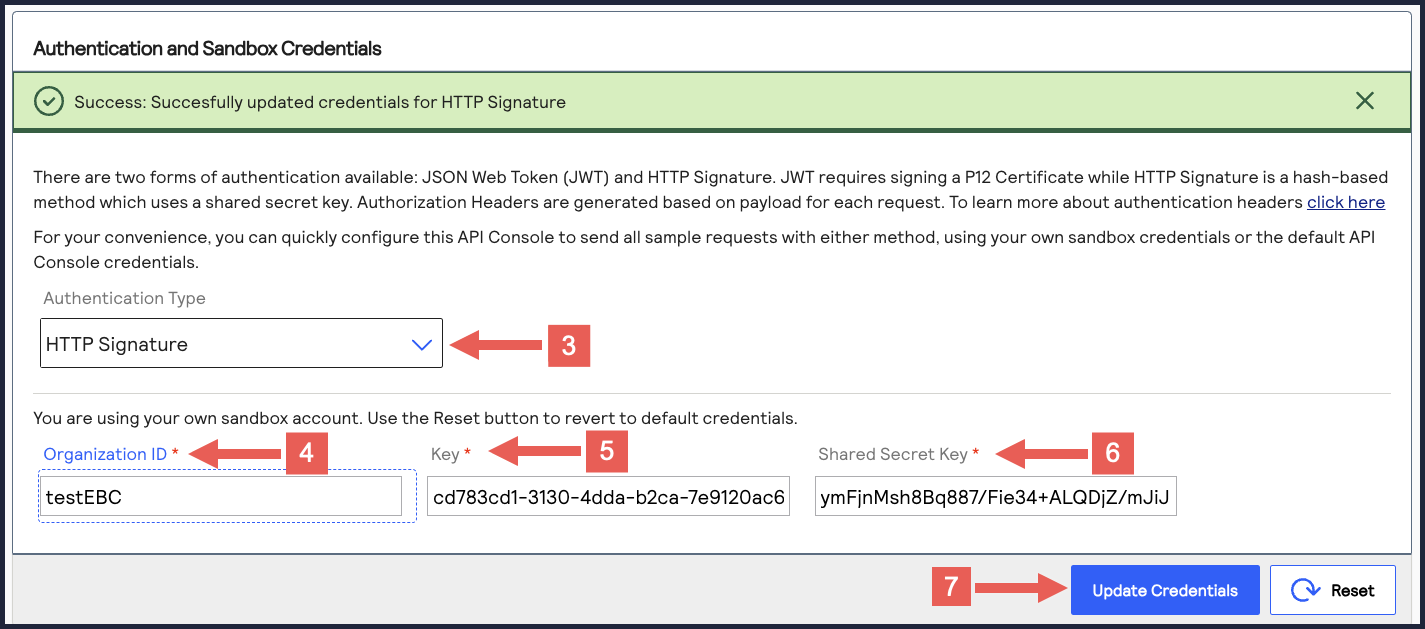
- Go to the Developer Center's API Reference and navigate toPayments >.POSTProcess a Payment
- ClickSend.
A message confirms that your request was successful with the status code 201.
- Log in to theBusiness Center:
- On the left navigation panel, choose
Transaction Management > Transactions.
- Under Search Results, verify that the request ID from the test authorization response is listed in the Request ID column.If the test authorization was successful, a success message is present in the corresponding Applications column.
Construct Messages Using JSON Web Tokens
WARNING
As of
February 2026
, there are new requirements for constructing
a JWT. This section explains how to update your system to remain in compliance. You must
update how your system constructs JWTs by March 2027
to remain compliant. You
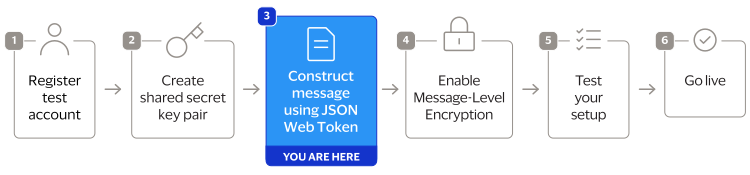
risk transaction failure if you do not update your system.To construct a message using JWTs, you must set the required HTTP headers, define the JWS
header and body claims, calculate the token signature, and combine these elements into a
request. This section describes how to create each element and construct the completed
JWT message in the following subsections.
Figure:
JWT Construction Steps
Enable Message-Level Encryption
IMPORTANT
There are additional tasks you must complete before you can enable message-level
encryption. See the Prerequisites for MLE section below.
This section explains how to enable MLE with JWT messaging.
Step 4A: Create or Submit a REST—API Response MLE
Key
Before you can enable your system to support MLE, you must create or upload a
REST—API
response MLE
certificate. After creating or uploading the certificate, you can
extract the certificate's key to begin enabling MLE. If your organization is using meta
keys, the shared secret key pair
and REST – API response MLE
key must be
created by the same portfolio or merchant account.Follow these steps to create or submit an API Response MLE certificate in
the
Business Center
:- Log in to theBusiness Center:
- On the left navigation panel, choose
Payment Configuration > Key Management.
- Click+ Generate keyon the Key Management page.
- Under REST APIs, chooseREST – API Response MLE, and then clickGenerate key.
- Choose one of these options to download your key:
- To create a new API response MLE certificate, clickDownload key
.
- To upload your own certificate, enter your public PEM-formatted certificate in the text box, and then clickDownload key
. The
.pemfile downloads to your desktop. If prompted by your system, approve the location to which the file downloads.
- If you are creating a certificate, the Set a Password window appears. Create a password for the certificate by entering the password into theNew PasswordandConfirm Passwordfields, and then clickGenerate key.The.p12file downloads to your desktop. If prompted by your system, approve the location to which the key downloads.
To create or submit another key, clickGenerate another key. To view all of your created keys, go to the Key Management page.IMPORTANTSecurely store the.p12file and password in your system. These credentials are required in order to implement certain products, and you must be able to access them.
- ClickCancel.The Key Management page appears.
- Click theKey Typefilter and chooseREST-API Response MLE.
- Click theExpires Atfilter and chooseAll Dates.
- ClickSearch.
- Find the REST–API Response key that you created in the Search Results table and save its key ID.The key ID is needed to test and configure your system to use MLE.
Step 4C: Set Up MLE
Use the information in this section to configure your system with a custom MLE using
JWTs.
If you do not want to set up a custom MLE, you can use the REST Client SDK
instead. For more information, see the REST Client SDKs in GitHub.
Figure:
Overview of MLE Set-Up Tasks
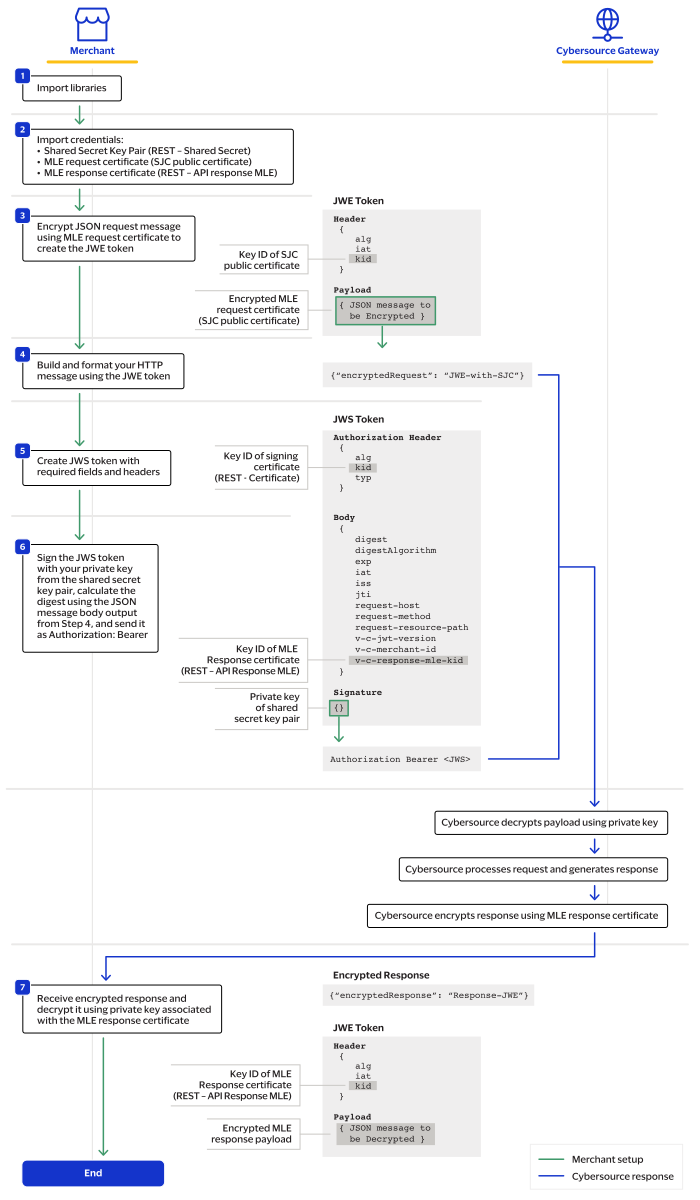
- Import the required programming libraries for your system.
- Import these three credentials:
- Shared secret key pair (REST API key)
- MLE request certificate (SJC public certificate)
- MLE response certificate (REST – API Response MLE)
- Encrypt the JSON request message using a JSON Web Encryption (JWE) that uses the SJC public certificate.
- Create the HTTP body in this format:{"encryptedRequest": ".JWE-with-SJC"}
- Create the JSON Web Signature (JWS) payload with these JWT payload fields and your shared secret key. For descriptions of these fields, see the Headers table and Message Body Fields table in Construct Messages Using JSON Web Tokens.
- Sign the JWS with your private key from the shared secret key pair and send it asAuthorization: Bearer.
- Receive an encrypted response and decrypt it with the MLE private key. You will receive the response in this format:{"encryptedResponse": "JWE-with-ResponseMLECertificate"}The JWE contains a JOSE header containing these four default elements:"alg": "RSA-OAEP-256", // The algorithm used to encrypt the CEK. "enc": "A256GCM", // The algorithm used to encrypt the message. "iat": "1702493653", // The current timestamp in milliseconds. "kid": "keyId" // The serial number of the v-c-response-mle-kid from the authentication JWS in step 5.
Test Your Setup
Cybersource
recommends that you test and verify
that your payment system can securely send and receive REST API messages before
transitioning to a production account. Use the test examples provided in this section to
test your set up. You should also test any additional API requests that you will use in
your live environment. Test Your REST–API Response MLE Key
Follow these steps to verify that your API response MLE key is working. If you
have not already created or submitted an API response MLE certificate, see the Create or
Submit a REST—API Response MLE Key section in Enable Message-Level Encryption.
- Go to the REST API Reference page in theCybersourceDeveloper Center:
- On the left navigation panel, choose an API that supports MLE. For testing purposes, you can chooseIntelligent Commerce > Intelligent Commerce Product > Enroll a Card.MLE support is indicated byRequest MLEandResponse MLEat the top of the screen.
- Choose theMLE Configurationtab.
- In the Message Level Encryption Credentials section, enter your API response MLE key credentials:
- ClickUpdate Credentials.
- From theSenddrop-down menu, chooseSend Request with Message Level Encryption.
- ClickSend.
- If aSuccess: HTTP Status Code: 201message displays in the Response section, your REST—API response MLE key is verified as properly configured.
Going Live
Step 6B: Activate Your Merchant ID
- Sign in to the Support Center as an administrator.
- Enter your credentials and log in to your test environment. The organization ID is your MID.
- In theBusiness Center, go toSupport Cases > MID Configuration Request. The MID Configuration Request page should be open.
- ClickMID Activation.
- In theDescriptionfield, enter the merchant ID that you want to take live.
- Choose a processor configuration, and enter the name of your processor.If you are unsure of the processor name, contact your merchant service provider or your merchant acquiring bank.
- Choose the environments to which this change applies (test or production).
- ClickService Enablementand list the products and services that you intend to use.
- ClickSubmit.
Set Up a JSON Web Token Message Using the REST
SDK
To use the
Cybersource
REST Client SDK, you must complete the tasks
described in this section.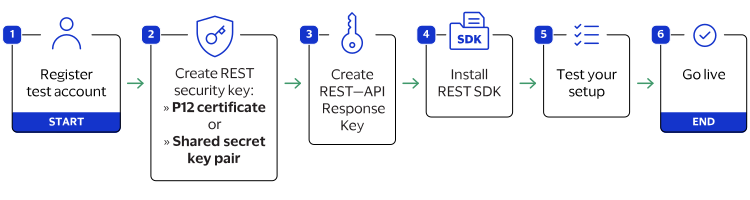
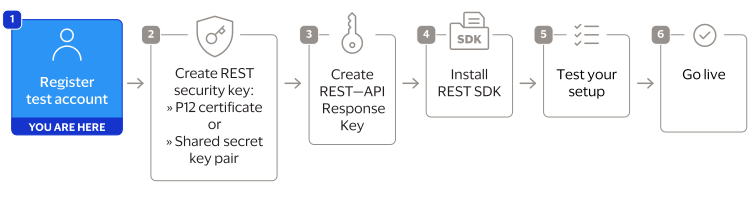
- Sign up for a test account. See Sign Up for a Test Account.
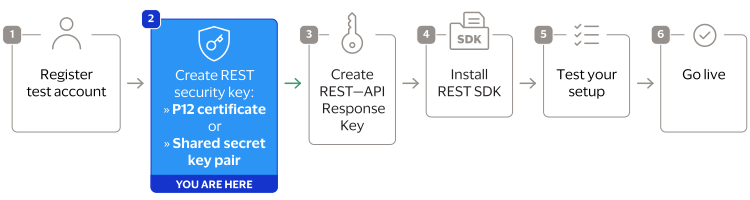
- Create an API security key, such as a P12 certificate or a shared secret key pair. See Create a Security Key.
- Create a REST–API Response Key in order to enable Message-Level Encryption. See Create REST–API Response Key.
- Install the REST SDK. See Install the REST SDK.
- Test your REST transaction messages. See Test Your Setup.
- Go live by transitioning your sandbox account into a production account. See Going Live.
Sign Up for a Test Account
To begin setting up your account, you must first sign up for a sandbox test account. A test
account enables you to obtain your security keys and test your implementation.
IMPORTANT
A test account cannot process live payments and is intended for only testing.
Follow these steps to sign up for a
sandbox test account:
- Go to theCybersourceDeveloper Center test account sign-up page:
- Enter your information into the test account form, and clickCreate Account.
- Go to your email and find a message titled:Merchant Registration Details. ClickSet up your username and password now.Your browser opens the New User Sign Up wizard.
- Enter the organization ID and contact email you supplied when you created your account. Follow the wizard pages to add your name, a username, and a password. Your username and password must meet these requirements:Username and Password RequirementsUsername RequirementsPassword Requirements
- Length must be 3-36 characters.
- Can only contain letters, numbers, periods, dashes, or underscores.
- Length must be 12–50 characters.
- Must contain one upper case letter.
- Must contain one lower case letter.
- Must contain one number.
- Cannot contain the username or organization ID.
- Log in to theBusiness Center.When you log in for the first time, you must verify your identity through a system-generated email sent to your email account.
- Check your email for a message titled:. A passcode is included in the message.CybersourceIdentification Code
- Enter the passcode on theVerify your Identitypage.You are directed to theBusiness Centerhome page.You have successfully signed up for a test account.IMPORTANTA test account cannot process live payments. After you verify that your system can send and receive REST messages, you can contact customer service to transition your test account to a production account.
Create a Security Key
This section describes how to create a security key and how to test that it works.
Choose one of these REST security key types to create in order to use the REST Client SDK:
- P12 certificate. For more information, see Create a P12 Certificate.
- Shared secret key pair. For more information, see Create a Shared Secret Key Pair.
Create a P12 Certificate
This section describes how to create or submit a P12 certificate, extract the certificate's
private key
, and test the private key to verify that it works. A private key
is necessary for you to construct JSON Web Tokens (JWTs). You can choose to create or submit a P12 certificate.
Create
a P12 certificate if
you need a new certificate. Submit
a P12 certificate if you want to use your own
certificate.- (Optional) Meta Keys
- If you are using a portfolio or merchant account, you have the option to create ameta keyof a P12 certificate. Meta keys enable an organization administrator to assign a single P12 certificate to some or all transacting merchants in their organization. The purpose of a meta key is to reduce the time needed to manage an organization's keys. For example, by assigning the same meta key to all of your transacting merchants, you only need to update one key when it expires instead of having to update each transacting merchant's key.
- For more information about meta keys, see the Meta Key Creation and Management section in theCreating and Using Security Keys User Guide.
Step 2A: Creating or Submitting a P12 Certificate
Follow these steps to create a P12 certificate file or submit your own certificate
signing request (CSR):
- Log in to theBusiness Center:
- On the left navigation panel, choose
Payment Configuration > Key Management.
- Click+ Generate keyon the Key Management page.
- Under REST APIs, chooseREST – Certificate, and then clickGenerate key.The Key Generation page appears.If you are using aportfolioaccount, the Key options window appears, giving you the choice to create a meta key.For more information about how to create a meta key, see .
The Confirmation Key Generation window appears.
- ClickDownload keyafter reviewing the key details.
The Key Generation page appears.
- (Optional) You can set the Certificate Expiry Timeframe field to the number of months you want the key to remain active before it expires. Only whole numbers from 1–36 are accepted. By default, new keys expire after 12 months.
- Choose from these two options:
- If you are a creating a new P12 Certificate, clickDownload key
.
- If you are submitting your own certificate, enter your public PEM-formatted certificate in the text box, then clickDownload key
.
- Create a password for the certificate by entering one into theNew PasswordandConfirm Passwordfields. ClickGenerate key.
The.p12file downloads to your desktop.If prompted by your system, approve the location to which the key downloads.
To create or submit another key, click
Generate another key
. To view all of
your created keys, go to the Key Management page.IMPORTANT
Securely store the
.p12
file and password in your system. These
credentials are required in order to implement certain products, and you must be
able to access them.Step 2B: Testing Your Private Key
After creating your key certificate, you must verify that it can successfully process
API requests. This task explains how to test and validate your private key in the
Developer Center and the
Business Center
.Follow these steps:
- Go to the Developer Center's API Reference page:
- On the left navigation panel, click .
- Under Authentication and Sandbox Credentials, go to the Authentication Type drop-down menu and chooseJSON Web Token.
- Enter your organization ID in theOrganizationfield.
- Enter your Password in thePasswordfield.
- ClickBrowseand upload your p12 certificate from your desktop.
- ClickUpdate Credentials.A confirmation message states that your credentials are successfully updated.
- Go to the Developer Center's API Reference and navigate toPayments >.POSTProcess a Payment
- ClickSend.
A message confirms that your request was successful with the status code 201.
- Log in to theBusiness Center:
- On the left navigation panel, choose
Transaction Management > Transactions.
- Under Search Results, verify that the request ID from the test authorization response is listed in the Request ID column.If the test authorization was successful, a success message is present in the corresponding Applications column.
Step 2A: Create a Shared Secret Key Pair
- On the left navigation panel, choose
Payment Configuration > Key Management.
- Click+ Generate keyon the Key Management page.
- Under REST APIs, chooseREST – Shared Secretand then clickGenerate key.
The REST API Shared Secret Key page appears.
- ClickGenerate keyafter reviewing the key details.
- ClickDownload key
.The.pemfile downloads to your desktop.
TheKeyvalue is yourkey IDand theShared Secretvalue is yourshared secret key.IMPORTANTSecurely store the key credentials and.pemfile in your system. These credentials are required in order to implement certain products, and you must be able to access them.
- What to do next
- To test your shared secret key pair, see Step 2B: Test Your Shared Secret Key Pair.
Step 2B: Test Your Shared Secret Key Pair
After creating your shared secret key pair, you must verify that your key pair can
successfully process API requests. Follow these steps to validate your key pair in
the Developer Center and the
Business Center
.- Go to the Developer Center's API Reference page:
- On the left navigation panel, click .
- Under Authentication and Sandbox Credentials, go to the Authentication Type drop-down menu and chooseHTTP Signature.
- Enter your organization ID in theOrganization IDfield.
- Enter your key ID in theKeyfield.
- Enter your shared secret key in theShared Secret Keyfield.
- ClickUpdate Credentials.A confirmation message displays stating that your credentials are successfully updated.
- Go to the Developer Center's API Reference and navigate toPayments >.POSTProcess a Payment
- ClickSend.
A message confirms that your request was successful with the status code 201.
- Log in to theBusiness Center:
- On the left navigation panel, choose
Transaction Management > Transactions.
- Under Search Results, verify that the request ID from the test authorization response is listed in the Request ID column.If the test authorization was successful, a success message is present in the corresponding Applications column.
Create REST–API Response Key
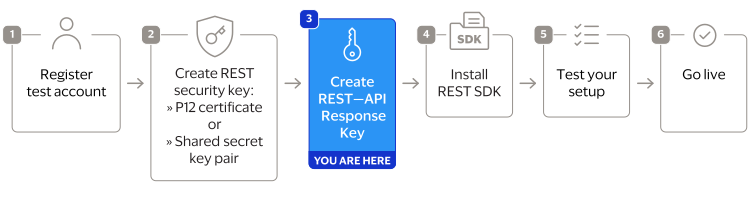
To enable message-level encryption (MLE) for your SDK integration, you must create a
REST–API response key. This section describes how to create and test a REST–API response
key.
Overview of MLE
Message-Level Encryption (MLE) enables you to store information or communicate with
other parties while helping to prevent uninvolved parties from understanding the
stored information. Enabling MLE requires you to create a
P12 certificate
or
shared secret key pair
for encrypting your requests and a REST – API
Response MLE
key for decrypting received responses. If your organization is
using meta keys, your security keys must be created by the same portfolio or
merchant account.Step 3A: Create or Submit a REST—API Response MLE
Key
Before you can enable your system to support MLE, you must create or upload a
REST—API
response MLE
certificate. After creating or uploading the certificate, you can
extract the certificate's key to begin enabling MLE. If your organization is using meta
keys, the shared secret key pair
and REST – API response MLE
key must be
created by the same portfolio or merchant account.Follow these steps to create or submit an API Response MLE certificate in
the
Business Center
:- Log in to theBusiness Center:
- On the left navigation panel, choose
Payment Configuration > Key Management.
- Click+ Generate keyon the Key Management page.
- Under REST APIs, chooseREST – API Response MLE, and then clickGenerate key.
- Choose one of these options to download your key:
- To create a new API response MLE certificate, clickDownload key
.
- To upload your own certificate, enter your public PEM-formatted certificate in the text box, and then clickDownload key
. The
.pemfile downloads to your desktop. If prompted by your system, approve the location to which the file downloads.
- If you are creating a certificate, the Set a Password window appears. Create a password for the certificate by entering the password into theNew PasswordandConfirm Passwordfields, and then clickGenerate key.The.p12file downloads to your desktop. If prompted by your system, approve the location to which the key downloads.
To create or submit another key, clickGenerate another key. To view all of your created keys, go to the Key Management page.IMPORTANTSecurely store the.p12file and password in your system. These credentials are required in order to implement certain products, and you must be able to access them.
- ClickCancel.The Key Management page appears.
- Click theKey Typefilter and chooseREST-API Response MLE.
- Click theExpires Atfilter and chooseAll Dates.
- ClickSearch.
- Find the REST–API Response key that you created in the Search Results table and save its key ID.The key ID is needed to test and configure your system to use MLE.
- Test Your REST–API Response MLE Key
- To test your REST–API Response key, see Test Your REST–API Response MLE Key.
Step 3B: Test Your REST-API Response Key
Follow these steps to verify that your API response MLE key is working:
- Go to the REST API Reference page in theCybersourceDeveloper Center:
- On the left navigation panel, choose an API that supports MLE. For testing purposes, you can chooseIntelligent Commerce > Intelligent Commerce Product > Enroll a Card.MLE support is indicated byRequest MLEandResponse MLEat the top of the screen.
- Choose theMLE Configurationtab.
- In the Message Level Encryption Credentials section, enter your API response MLE key credentials:
- Response encryption:Enter the key ID of your REST—API response MLE key.You saved this key ID in Step 10 in the Create or Submit a REST—API Response MLE Key section in Enable Message-Level Encryption.
- Response decryption:ClickBrowseto submit your own private decryption key from your local system. Only.p12files are supported.
- ClickUpdate Credentials.
- From theSenddrop-down menu, chooseSend Request with Message Level Encryption.
- ClickSend.
- If aSuccess: HTTP Status Code: 201message displays in the Response section, your REST—API response MLE key is verified as properly configured.
Install the REST SDK
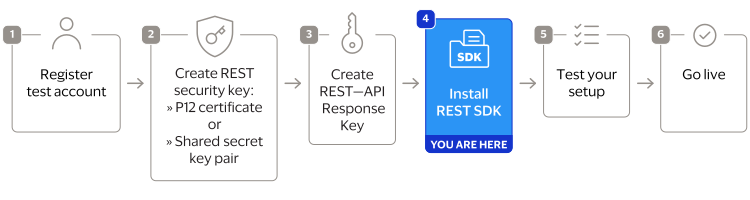
The
REST Client SDK
constructs JSON Web Token (JWT) messages for you to send to
Cybersource
. These messages are also encrypted using Message-Level
Encryption (MLE) by the SDK. When you receive a response message from Cybersource
, the SDK decrypts it using MLE.For more information about how to install the REST Client SDK into your system, see the
REST API related products
table in the Cybersource
GitHub.SDK Version
This table lists the minimum SDK versions that support the updated JWT message
construction and MLE requirements. Find your system’s processing language and
install the corresponding SDK version or a later version.
Language | Minimum SDK Version Required | MLE Enablement Instructions |
|---|---|---|
.NET Framework | v0.0.1.60 | |
.NET Standard or .NET Core | v0.0.1.52 | |
Test Your Setup
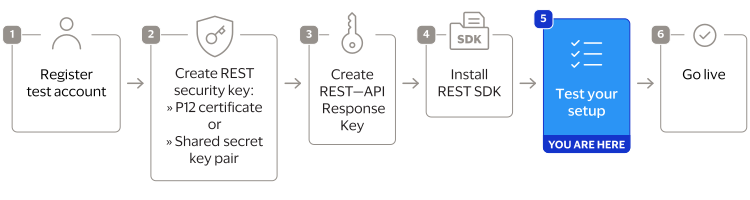
Cybersource
recommends that you test and verify
that your payment system can securely send and receive REST API messages before
transitioning to a production account. Use the test examples provided in this section to
test your set up. You should also test any additional API requests that you will use in
your live environment. If you receive unsuccessful responses, verify that your security keys work and that the
key information is correctly entered into the SDK.
Completing a Test Transaction
After setting up your system to be REST compliant, you can send these test requests
to verify that you can send and receive REST API messages.
IMPORTANT
Depending on your payment processor, you may be required to send additional
fields that are not shown in these examples.
Follow these steps to verify that you can complete a test transaction:
- Authorize a Payment
- You send this POST request to theendpoint:https://apitest.cybersource.com/pts/v2/payments{ "orderInformation": { "billTo": { "country": "US", "lastName": "Kim", "address1": "201 S. Division St.", "postalCode": "48104-2201", "locality": "Ann Arbor", "administrativeArea": "MI", "firstName": "Kyong-Jin", "email": "" }, "amountDetails": { "totalAmount": "100.00", "currency": "USD" } }, "paymentInformation": { "card": { "expirationYear": "2031", "number": "4111111111111111", "expirationMonth": "12", "type": "001" } } }
- You receive a successful response and store the authorization transaction ID in theidfield. A successful response is indicated by a 201 HTTP status code."id" : "6461731521426399003473"
- Capture an Authorized Payment
- You send this POST request to theendpoint and include the authorization transaction ID as thehttps://apitest.cybersource.com/pts/v2/payments/{id}/captures:{id}https://apitest.cybersource.com/pts/v2/payments/6461731521426399003473/captures{ "clientReferenceInformation": { "code": "ABC123" }, "orderInformation": { "amountDetails": { "totalAmount": "100.00", "currency": "USD" } }
- You receive a successful response and store the capture transaction ID in theidfield. A successful response is indicated by a 201 HTTP status code."id": "6772994431376681303954"
- Refund a Captured Payment
- You send this POST request to theendpoint and include the capture transaction ID as thehttps://apitest.cybersource.com/pts/v2/payments/{id}/refunds:{id}https://apitest.cybersource.com/pts/v2/payments/6772994431376681303954/refunds{ "orderInformation": { "amountDetails": { "totalAmount": "100.00", "currency": "USD" } } }
- You receive a successful response, which verifies that your system can complete a transaction. A successful response is indicated by a 201 HTTP status code.
Going Live
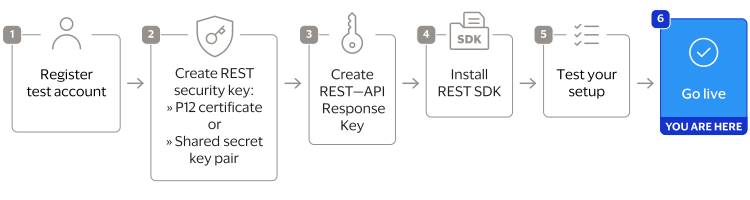
Step 6B: Activate Your Merchant ID
- Sign in to the Support Center as an administrator.
- Enter your credentials and log in to your test environment. The organization ID is your MID.
- In theBusiness Center, go toSupport Cases > MID Configuration Request. The MID Configuration Request page should be open.
- ClickMID Activation.
- In theDescriptionfield, enter the merchant ID that you want to take live.
- Choose a processor configuration, and enter the name of your processor.If you are unsure of the processor name, contact your merchant service provider or your merchant acquiring bank.
- Choose the environments to which this change applies (test or production).
- ClickService Enablementand list the products and services that you intend to use.
- ClickSubmit.
Set Up an HTTP Signature Message
To set up HTTP signature messaging, you must complete the tasks described in this
section.
WARNING
By
March 2027
, all merchants using HTTP signature
messaging must migrate to JSON Web Token (JWT) messaging in order to support
message-level encryption (MLE). You risk transaction failures if you do not
implement this update. If you are setting up your system to be REST-compliant for
the first time, Cybersource
recommends using JWT messaging.To
update your system to support JWT messaging, use one of these methods:
Figure:
Set Up HTTP Signature Messaging
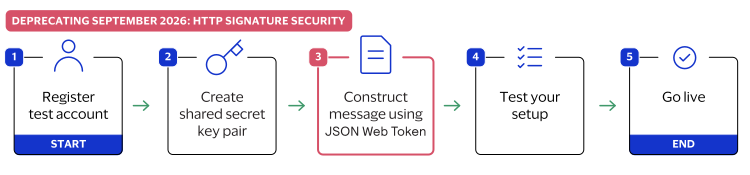
- Sign up for a test account. See Sign Up for a Test Account.
- Create a shared secret key. See Create a Shared Secret Key Pair.
- Construct a message using HTTP signature security. See Construct Messages Using HTTP Signature Security.
- Test your REST transaction messages. See Test Your Setup.
- Go live by transitioning your sandbox account into a production account. Going Live.
Sign Up for a Test Account
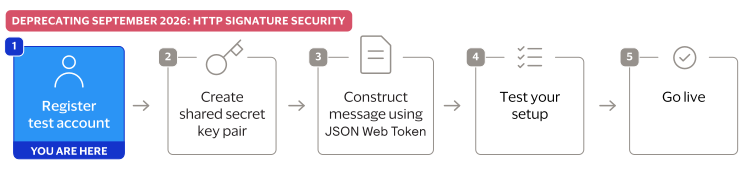
To begin setting up your account, you must first sign up for a sandbox test account. A test
account enables you to obtain your security keys and test your implementation.
IMPORTANT
A test account cannot process live payments and is intended for only testing.
Follow these steps to sign up for a
sandbox test account:
- Go to theCybersourceDeveloper Center test account sign-up page:
- Enter your information into the test account form, and clickCreate Account.
- Go to your email and find a message titled:Merchant Registration Details. ClickSet up your username and password now.Your browser opens the New User Sign Up wizard.
- Enter the organization ID and contact email you supplied when you created your account. Follow the wizard pages to add your name, a username, and a password. Your username and password must meet these requirements:Username and Password RequirementsUsername RequirementsPassword Requirements
- Length must be 3-36 characters.
- Can only contain letters, numbers, periods, dashes, or underscores.
- Length must be 12–50 characters.
- Must contain one upper case letter.
- Must contain one lower case letter.
- Must contain one number.
- Cannot contain the username or organization ID.
- Log in to theBusiness Center.When you log in for the first time, you must verify your identity through a system-generated email sent to your email account.
- Check your email for a message titled:. A passcode is included in the message.CybersourceIdentification Code
- Enter the passcode on theVerify your Identitypage.You are directed to theBusiness Centerhome page.You have successfully signed up for a test account.IMPORTANTA test account cannot process live payments. After you verify that your system can send and receive REST messages, you can contact customer service to transition your test account to a production account.
Create a Shared Secret Key Pair
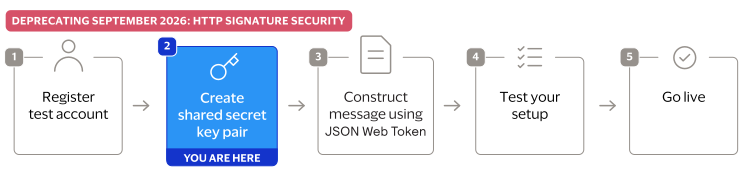
You must create a shared secret key pair to use HTTP signature message security.
All account users can create their own unique shared secret key pair. In
addition, portfolio and merchant account users can also create a
meta key
of a
shared secret key pair. Meta keys enable an organization administrator to assign a
single shared secret key pair to some or all transacting merchants in their
organization. The purpose of a meta key is to reduce the time needed to manage an
organization's keys. For example, by assigning the same meta key to all of your
transacting merchants, you need to update only one key when it expires instead of having
to update each transacting merchant's key when it expires.For more information about meta keys, see the
Meta Key Creation and
Management section in the
Creating and Using Security Keys User
Guide
.Figure:
Account Type Overview
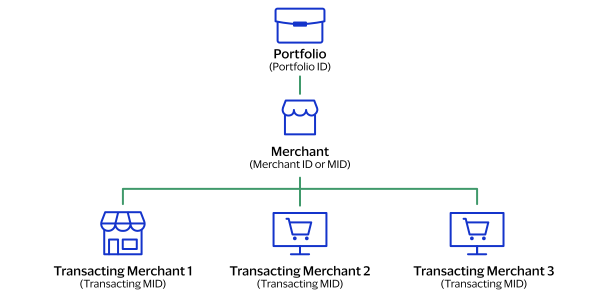
- Portfolio
- A portfolio account represents the partner administrator user. This account type can create and manage merchant accounts in the test and production environments.
- Merchant
- A merchant account represents the merchant administrator user. This account type can create and manage multiple transacting merchant accounts in their organization.
- Transacting Merchant
- A transacting merchant represents the merchant user who is processing transactions. This account type is typically the account that sends API requests.
Step 2A: Creating a Shared Secret Key Pair
Follow these steps to create a shared secret key pair:
- Log in to theBusiness Center:
- On the left navigation panel, choose
Payment Configuration > Key Management.
- Click+ Generate keyon the Key Management page.
- Under REST APIs, chooseREST – Shared Secretand then clickGenerate key.
The REST API Shared Secret Key page appears.
- ClickGenerate keyafter reviewing the key details.
- ClickDownload key
.The.pemfile downloads to your desktop.
TheKeyvalue is yourkey IDand theShared Secretvalue is yourshared secret key.IMPORTANTSecurely store the key credentials and.pemfile in your system. These credentials are required in order to implement certain products, and you must be able to access them.
To create or submit another key, click
Generate another key
. To view all of
your created keys, go to the Key Management page.- What to do next
- To test your shared secret key pair, see Step 2B: Test Your Shared Secret Key Pair.
Step 2B: Test Your Shared Secret Key Pair
After creating your key certificate, you must verify that your key can successfully
process API requests. Follow these steps to validate your key certificate in the
Developer Center and the
Business Center
.- Go to the Developer Center's API Reference page:
- On the left navigation panel, click .
- Under Authentication and Sandbox Credentials, go to the Authentication Type drop-down menu and chooseHTTP Signature.
- Enter your organization ID in theOrganization IDfield.
- Enter your key, also known as your private key, in theKeyfield.
- Enter your secret key, also known as your public key, in theShared Secret Keyfield.
- ClickUpdate Credentials.
- Go to the Developer Center's API Reference and navigate toPayments >.POSTProcess a Payment
- ClickSend.
A message confirms that your request was successful with the status code 201.
- Log in to theBusiness Center:
- On the left navigation panel, choose
Transaction Management > Transactions.
- Under Search Results, verify that the request ID from the test authorization response is listed in the Request ID column.If the test authorization was successful, a success message is present in the corresponding Applications column.
Construct Messages Using HTTP Signature Security
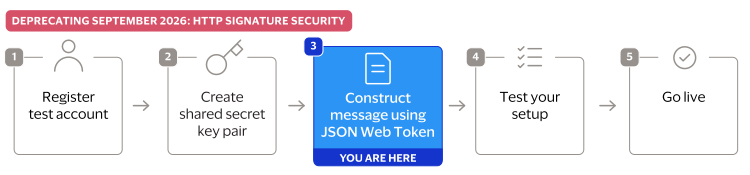
HTTP signatures use a digital signature to enable the receiver to validate the sender's
authenticity and ensure that the message was not tampered with during transit. For more
information about HTTP signatures, see the IETF Draft that is maintained by the IETF HTTP
Working Group.
Follow these steps to create messages using HTTP signatures:
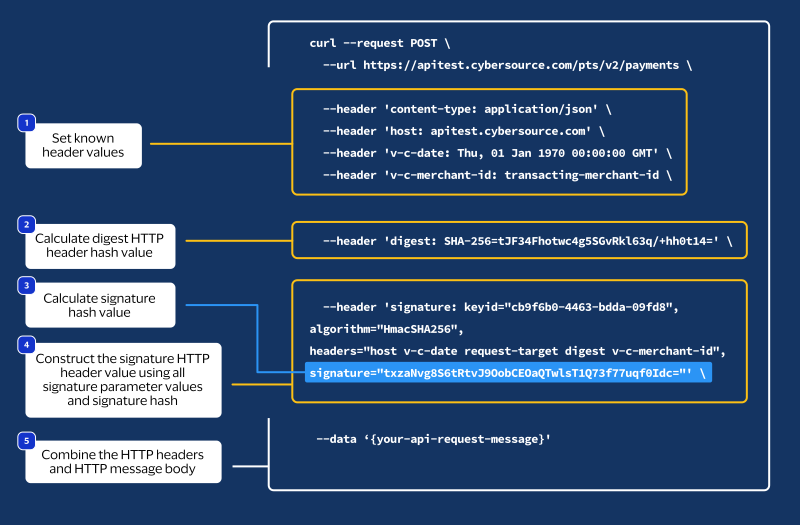
HTTP Message Elements
An HTTP message is constructed using HTTP headers and an HTTP message body.
- HTTP Message Headers
- Your message header must include these HTTP header fields:HTTP Header FieldsHTTP Header FieldDescriptioncontent-typeAlso known as the Multipurpose Internet Mail Extension (MIME) type, it is the identifier of the media or file type resource. You can set the value to:application/jsonhostThe transaction endpoint (api.cybersource.com).v-c-dateThe date of the transaction in the RFC1123 format. Example:Thu, 18 Jul 2019 00:18:03 GMTv-c-merchant-idYourCybersourcetransacting merchant ID (MID).If you are a portfolio or merchant account user, set this to the transacting merchant ID you send requests on behalf of.digestA hash of the HTTP message body that contains your API request.The digest field does not apply toGETAPI requests.signatureThe digital signature, which is constructed using the values of the other headers and secured by your private key.
- HTTP Message Body
- Your API request.
Step 3A: Set Known HTTP Header Values
Set these HTTP header values, which do not require calculation:
- content-type
- Set to the media or file type resource.
- host
- Set to the transaction endpoint.
- v-c-date
- Set to the transaction date in RFC1123 format.
- v-c-merchant-id
- Set to a transacting merchant ID.
Step 3B: Digest Hash Calculation
The value of the
digest
HTTP header is a hashed version of the HTTP message
body that you must calculate. This hash value validates the integrity of your
message by the receiver.Follow these steps to calculate the digest hash:
- Generate the SHA-256 hash of the JSON payload (message body).
- Encode the hashed string to Base64.
- PrependSHA-256=to the front of the hash.
- Add the message body hash to thedigestHTTP header field.
Creating a Message Hash Using the Command Line
shasum
Toolecho -n "{"clientReferenceInformation":{"code":"TC50171_3"},"paymentInformation":{"card":{"number": "4111111111111111","expirationMonth":"12","expirationYear":"2031"}},"orderInformation":{"amountDetails": {"totalAmount":"102.21","currency":"USD"},"billTo”:{“firstName":"John","lastName":"Doe","address1": "1MarketSt","locality":"sanfrancisco","administrativeArea":"CA","postalCode":"94105","country":"US", "email":"","phoneNumber":"4158880000"}}}" | shasum -a 256
echo -n "6ae5459bc8a7d6a4b203e8a734d6a616725134088e13261f5bbcefc1424fc956" | base64
Creating a Message Hash Using the Command Line
base64
Toolecho -n "6ae5459bc8a7d6a4b203e8a734d6a616725134088e13261f5bbcefc1424fc956" | base64
Creating a Message Hash Using C#
public static string GenerateDigest() {
				var digest = "";
				var bodyText = "{ your JSON payload }";
				using (var sha256hash = SHA256.Create()) {
				byte[] payloadBytes = sha256hash
				.ComputeHash(Encoding.UTF8.GetBytes(bodyText));
				digest = Convert.ToBase64String(payloadBytes);
				digest = "SHA-256=" + digest;
				}
				return digest;
				}
Creating a Message Using Java
public static String GenerateDigest() throws NoSuchAlgorithmException {
				String bodyText = "{ your JSON payload }";
				MessageDigest md = MessageDigest.getInstance("SHA-256");
				md.update(bodyText.getBytes(StandardCharsets.UTF_8));
				byte[] digest = md.digest();
				return "SHA-256=" + Base64.getEncoder().encodeToString(digest);
				}
Step 3C: Signature Hash Calculation
Before you can construct the
signature
HTTP header value, you must first
generate the signature hash
. To generate the signature hash value, you must use a
Base64-encoded HMAC SHA-256 hash of the signature fields and their values. This table describes the signature field values that you must use to calculate the signature
hash.
Signature Field | Description |
|---|---|
v-c-date | From the header, the date and time in the RFC1123 format. For example: Date: Thu, 18 Jul 2023,
22:18:03. |
Digest | The Base64-encoded SHA-256 hash of the message body. For more
information, see Step 3B: Digest Hash Calculation. Example: Digest:
SHA-256=gXWufV4Zc7VkN9Wkv9jh/JuAVclqDusx3vkyo3uJFWU= Do not include the digest with GET requests. |
Host | From the header, the endpoint host. For example: apitest.cybersource.com |
v-c-merchant-id | From the header, the merchant ID associated with the request. For example: v-c-merchant-id: mymerchantid . |
request-target | The HTTP method and endpoint resource path. For example: request-target: post /pts/v2/payments .IMPORTANT
Verify that your request-target values match exactly the resource
path. For example, /pts/v2/payments is not
the same as
/pts/v2/payments ./ |
Follow these steps to generate the signature hash value:
- Generate a byte array of the secret key generated previously. For more information, see Create a Shared Secret Key Pair.
- Generate the HMAC SHA-256 key object using the byte array of the secret key.
- Concatenate a string of the required information listed above.For more information, see Creating the Validation String below.
- Generate a byte array of the validation string.
- Use the HMAC SHA-256 key object to create the HMAC SHA-256 hash of the validation string byte array.
- Base64-encode the HMAC SHA-256 hash.
Signature Hash
signature=”OuKeDxj+Mg2Bh9cBnZ/25IXJs5n+qj93FvPKYpnqtTE=”
Creating the Validation String
To create the validation string, concatenate the required information in the same order as listed in the signature header field parameter. Each
item must be on a separate line, and each line should be terminated with a new line character
\n
.Validation String Example
host:apitest.cybersource.com\n date: Thu, 18 Jul 2019 00:18:03 GMT\n request-target: post /pts/v2/payments/\n digest: SHA-256=gXWufV4Zc7VkN9Wkv9jh/JuAVclqDusx3vkyo3uJFWU=\n v-c-merchant-id: mymerchantid
Generating a Signature Hash in C#
private static string GenerateSignatureFromParams(string signatureParams, string secretKey) {
var sigBytes = Encoding.UTF8.GetBytes(signatureParams);
var decodedSecret = Convert.FromBase64String(secretKey);
var hmacSha256 = new HMACSHA256(decodedSecret);
var messageHash = hmacSha256.ComputeHash(sigBytes);
return Convert.ToBase64String(messageHash);
}
Generating a Signature Hash in Java
public static String GenerateSignatureFromParams(String keyString,
String signatureParams) throws InvalidKeyException, NoSuchAlgorithmException {
byte[] decodedKey = Base64.getDecoder().decode(keyString);
SecretKey originalKey = new SecretKeySpec(decodedKey, 0, decodedKey.length, "HmacSHA256");
Mac hmacSha256 = Mac.getInstance("HmacSHA256");
hmacSha256.init(originalKey);
hmacSha256.update(signatureParams.getBytes());
byte[] HmachSha256DigestBytes = hmacSha256.doFinal();
return Base64.getEncoder().encodeToString(HmachSha256DigestBytes);}
Step 3D: Constructing the Signature Header
After you generate a signature hash, you can construct the
signature
HTTP header value.The
signature
HTTP header value is constructed using these
parameters:Signature Parameter | Description |
|---|---|
keyid | The serial number of the signing certificate/key pair. Obtain
this in the Business Center Key Management area. For more
information, see Step 2A: Creating a Shared Secret Key Pair. |
algorithm | The HMAC SHA256 algorithm used to encrypt the signature. It
should be formatted: HmacSHA256 . |
headers | The signed-header values calculated in the signature:
IMPORTANT
If you are using a meta-key, set the
v-c-merchant-id signature-parameter
value to the meta-key creator's ID. Then set the
v-c-merchant-id HTTP header value to
the transacting merchant ID (MID) that you are sending a
request on-behalf of. |
signature | The signature hash. |
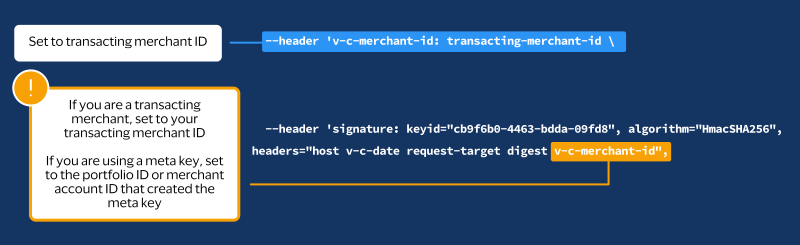
- Signature Field Format
- Signature:"keyid:"[keyid]",algorithm="[encryption algoritm]",headers="field1" "field2" "field3" "etc.", signature="[signature hash]"
- Signature Example
- Signature:"keyid="123abcki-key1-key2-key3-keyid1234567", algorithm="HmacSHA256", headers="host date request-target digest v-c-merchant-id", signature="hrptKYTtn/VfwAdUqkrQ0HT7jqAbagAbFC6nRGXrNzE="
Step 3E: Complete Message with HTTP Signature
Combine all of the HTTP header values with your HTTP message body to construct your HTTP
signature message.
To test your message, you can send a test request to
Cybersource
. For
more information, see Test Your Setup.Test Your Setup
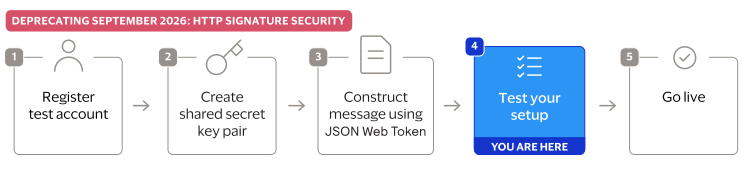
You can send a test API request to validate that your account, API key, HTTP headers, and
HTTP message body are working as intended.
Cybersource
recommends that you test and verify
that your payment system can securely send and receive REST API messages before
transitioning to a production account. Use the test examples provided in this section to
test your set up. You should also test any additional API requests that you will use in
your live environment. Going Live
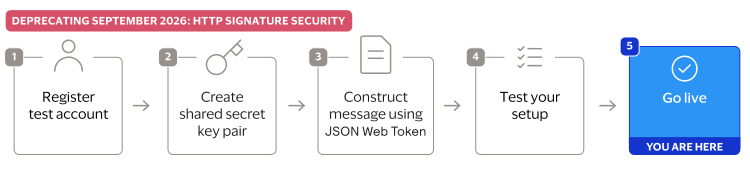
When you are ready to process payments in a live environment, you must
transition your account to the live status with a valid configuration for your chosen
payment processor. When your account is live, your transaction data flows through the
production
Cybersource
gateway, to your processor, and on to the
appropriate payment network.To transition your account:
- Sign up for a merchant account.
- to establish a contract withCybersourcethat enables you to process real transactions and receive support.
- Submit a merchant ID (MID) activation request.
It can take up to three business days for the MID to become active.
Step 5A: Create a Merchant ID
Your merchant ID (MID) identifies you and your transactions, which requires
you to include it in each transaction request. When you signed up for a sandbox account,
you received a merchant ID for testing purposes. If you choose, you can use that
merchant ID as your production ID.
Follow these steps to sign up for a merchant account in order to create a production MID:
- Go to theBusiness CenterSandbox Account Sign Up page, enter the required information, and clickCreate Account.Choose your merchant ID name. It cannot be changed. This name is not visible to your customers.
- Review your information entered, especially your business email address. Your merchant ID registration information will be sent to the email entered on this form.
- Look for an email from customer support titled:.CybersourceMerchant Evaluation AccountThis email contains your organization ID and contact email associated with your MID.
- Look for an email titled:Merchant Registration Details. Click theSet up your username and password nowlink.Your browser opens the New User Sign Up wizard.
- Enter the organization ID and contact email you supplied previously. Follow the wizard pages to add your name, a username, and password.
- Log in to theBusiness Center.When you log in for the first time, you will be asked to identify yourself through a system-generated email that is sent to your email account.
- Look for an email titled:. Save the passcode in the email.CybersourceIdentification Code
- Enter the passcode on the Verify your Identity page. You are directed to theBusiness Centerhome page.
You have successfully created a merchant ID and merchant account.
Step 5B: Activate Your Merchant ID
The activation process, also known as
going live
, transitions your
MID and account from test status to live status, enabling you to process real
transactions. It can take up to three business days for your MID to become active.To transition your account, complete these steps:
- Sign in to the Support Center as an administrator.
- Enter your credentials and log in to your test environment. The organization ID is your MID.
- In theBusiness Center, go toSupport Cases > MID Configuration Request. The MID Configuration Request page should be open.
- ClickMID Activation.
- In theDescriptionfield, enter the merchant ID that you want to take live.
- Choose a processor configuration, and enter the name of your processor.If you are unsure of the processor name, contact your merchant service provider or your merchant acquiring bank.
- Choose the environments to which this change applies (test or production).
- ClickService Enablementand list the products and services that you intend to use.
- ClickSubmit.
Production Endpoints
Send API requests using your production account to the production server:
https://api.cybersource.com
For example, send a live authorization request to this endpoint:
https://api.cybersource.com
/pts/v2/paymentsVisa Platform Connect: Specifications and Conditions for
Resellers/Partners
The following are specifications and conditions that apply to a Reseller/Partner enabling
its merchants through
Cybersource for
. Failure to meet any of the specifications and conditions below is
subject to the liability provisions and indemnification obligations under
Reseller/Partner’s contract with Visa/Cybersource.Visa Platform Connect
(“VPC”)
processing- Before boarding merchants for payment processing on a VPC acquirer’s connection, Reseller/Partner and the VPC acquirer must have a contract or other legal agreement that permits Reseller/Partner to enable its merchants to process payments with the acquirer through the dedicated VPC connection and/or traditional connection with such VPC acquirer.
- Reseller/Partner is responsible for boarding and enabling its merchants in accordance with the terms of the contract or other legal agreement with the relevant VPC acquirer.
- Reseller/Partner acknowledges and agrees that all considerations and fees associated with chargebacks, interchange downgrades, settlement issues, funding delays, and other processing related activities are strictly between Reseller and the relevant VPC acquirer.
- Reseller/Partner acknowledges and agrees that the relevant VPC acquirer is responsible for payment processing issues, including but not limited to, transaction declines by network/issuer, decline rates, and interchange qualification, as may be agreed to or outlined in the contract or other legal agreement between Reseller/Partner and such VPC acquirer.
DISCLAIMER: NEITHER VISA NOR CYBERSOURCE WILL BE RESPONSIBLE OR LIABLE FOR ANY ERRORS OR
OMISSIONS BY THE
Visa Platform Connect
ACQUIRER IN PROCESSING TRANSACTIONS. NEITHER VISA
NOR CYBERSOURCE WILL BE RESPONSIBLE OR LIABLE FOR RESELLER/PARTNER BOARDING MERCHANTS OR
ENABLING MERCHANT PROCESSING IN VIOLATION OF THE TERMS AND CONDITIONS IMPOSED BY THE
RELEVANT Visa Platform Connect
ACQUIRER.